
By libby
July 17, 2007 · 8 Comments
This is the third and last of my Chicago posts. Here are the the first post and the second one.
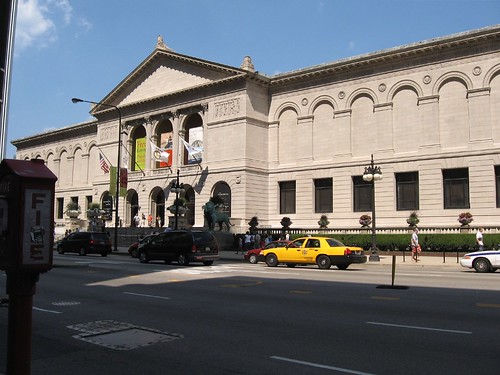
I suppose it’s silly to write a post that says the Art Institute of Chicago is a great museum. But that’s what I’m going to do. Here’s a picture of the Beaux Arts building that houses it, completed the year of the Chicago World’s Fair (1893).
And to think, if not for the beastly hot weather, I might have missed the place. But on our last day, we needed someplace to go that was indoors and cool.
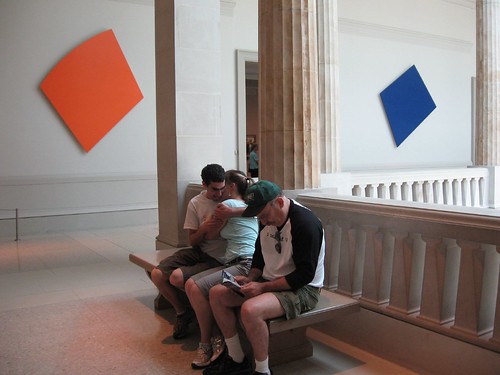
Ellsworth paintings surrounded the atrium.
It just so happens that the current special exhibit–the Jeff Wall retrospective–was one Roberta and I had seen at MoMA. So I saw it again. When we were done, we paused for a break in a lovely atrium that reminded me of the atrium at the Carnegie (similar style building, similar method of construction, I’d guess). The Ellsworth Kelly paintings lining the walls, in spite of their Pop colors and glistening materials, made me think of Richard Tuttle’s cloth pieces and wire pieces, with their imaginary projections in space.
But it’s the Impressionists and post that really make this museum a must-visit place. I mean, a whole room of Manet, a whole wall of his haystacks!! Or Seurat’s Grande Jatte!!
Kandinsky and Feininger (maybe the best of his I’ve ever seen) and Chagall and Klee, all in one room, popped with glorious gumdrop colors.
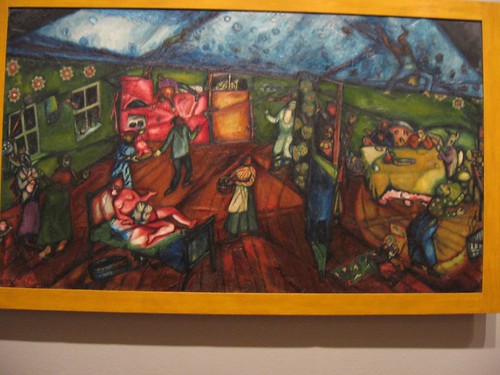
Marc Chagall, Birth, 1911/1913
This Chagall has none of the sentimentality that later success encouraged. It has lots to look at, and shows his sense of the supernatural in the everyday. The stained glass-like colors and lines are surprising in paint; so is the subject matter surprising. There’s something odd and improper going on here, with the interior spaces exposed and the mother exposed with half the town walking through the inside/outside.
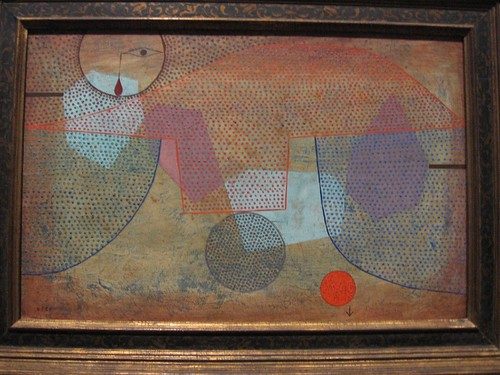
And all of the Klee pieces looked bright and pretty current to me. I began comparing him to Miro. I guess that’s kind of obvious, but for some reason, seeing all those Klees in a row brought it home to me.
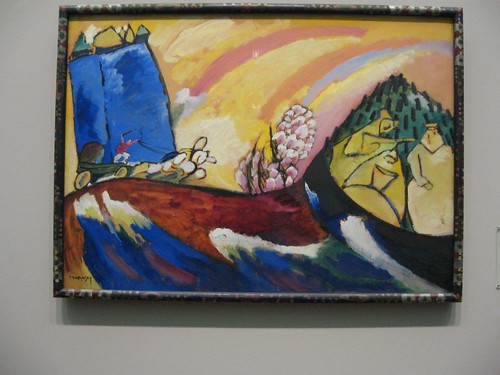
Vasily Kandinsky, Painting With Troika, 1911, oil on cardboard
The Kandinskys came from different stages in his work. So some of them looked like Kandinsky as we know him. But some of them looked Impressionist and Chagall-like. This modest one has bits of Klee-like imagery, bits of Chagall’s humanity and folkiness. In all of the Kandinskys, the colors were fabulous.
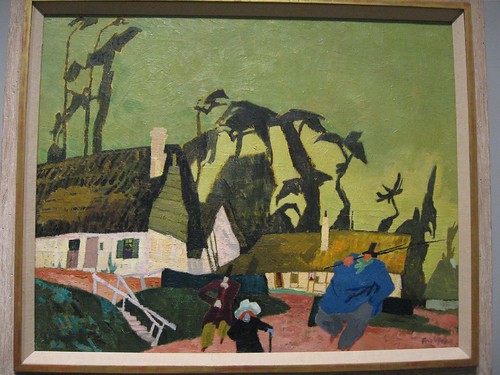
Lionel Feininger, Longeuil, Normandie, 1909
Even Lionel Feininger, less of a luminary, looked darned luminous and beautiful here. I loved his work when I was in college, and here I was, a fan all over again. I could see shades of Gauguin in his very French landscape.
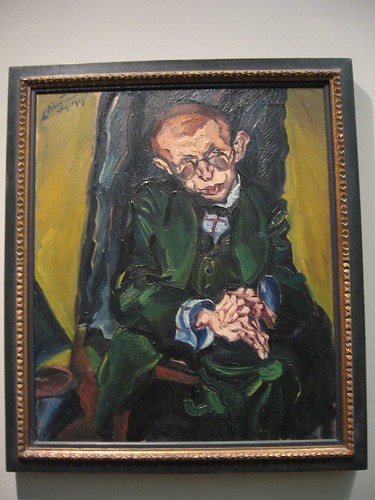
Ludwig Meidner’s portrait of Max Herrmann-Neisse, 1913
Ludwig Meidner, a German artist from the same period, seems to fill the gap between Haim Soutine and Alice Neel. I never even heard of him!
I do want to observe that some of the excellence of the colors may have something to do with the lighting here, which is so well done that paintings that might otherwise die rise magically off the walls.
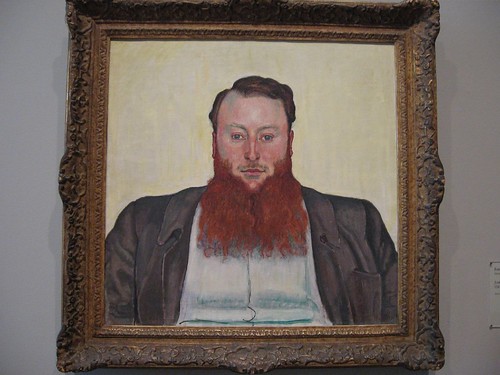
Ferdinand Hodler, James Vibert, sculptor, 1907, oil on canvas
A little past the Grande Jatte, I found this hilarious painting by Swiss artist Ferdinand Hodler (on the wall next to the scariest Hodler ever). It’s a remarkable image, between the hair obsession, the square obsession, the brush-stroke obsession, and the colors.
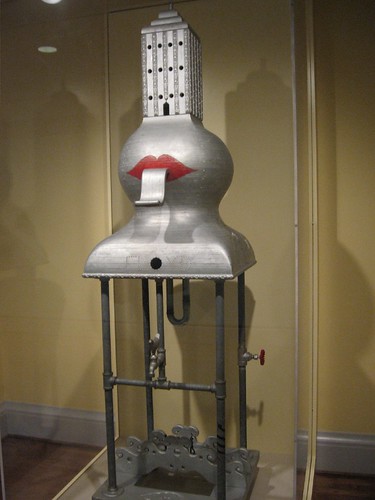
Angry Young Machine, by H.C. Westermann, 1960, wood and metal
Just before I left, down in the basement near the Ladies Room, I came upon this H.C. Westermann. To see the Chicago deco architecture merge with the witty plumbing was a nice end to the visit, especially since Westermann, who is a Chicago guy and studied at the AIC, is having a show at PAFA right now. More on that later.
Honestly, the AIC is worth a trip all on its own.
Tags: art institute of chicago, ellsworth kelly, ferdinand hodler, h.c. westermann, lionel feininger, ludwig meidner, marc chagall, paul klee, vasily kandinsky
I’m going to sheepishly ask: Aren’t those multiple shaped canvases in the contemporary wing Ellsworth Kelly’s? I kind of always assumed they were, I can’t ever remember reading the label, though. And nothing on the AIC website corroborates my claim.
As an aside, I visited the Stuart Davis WNYC mural in the Met a short time ago, and was struck by how much more dynamic it was than the Stella work in the next room. Great painting!
I am a dedicated reader of your weblog and consider it a great resource. Thanks!
Just wanted to note that the shaped canvases in the Rice Building are by Ellsworth Kelly.
I 3rd the Kelly thing. But also want to say I recognize Max Herrmann-Neisse from the Glitter and Doom show at the Met back in the winter. A great great show that really sticks in my mind. I know Grosz painted him but something tells me that guy made his way into a lot of the works at that show. George Grosz
Well, first of all, thanks, Pete, for your nice comments on the blog. All of you who know way more than I do are of course right about Ellsworth Kelly. I’m afraid it’s my mind playing tricks on me.
I am a little confused, Jim, about what you’re saying about the Meidner painting, which is indeed by Meidner. Are you saying Meidner is Grosz, or that Meidner is sometimes passed off as Grosz??? I’m just unclear. Either way, whoever painted it deserves a gold star. It’s a beauty.
So I’m now fixing Ellsworth Kelly. Sorry, all.
No, no. I just recognized the guy in the portrait as having been in the Grosz painting and possibly in other ones from the show Glitter and Doom. I wasn’t questioning the artist whom I also have never heard of. I didn’t mean to confuse.
Max Herrmann-Neisse (the model) seems like a very memorable character.
I noodled around the web a little for who Herrmann-Neisse is and learned he was an award-winning poet, writer and an activist. His real name was Max Herrmann, but he added Neisse, his home town, to his name at some point. He also apparently appeared in some Max Beckmann paintings. Here’s a link to the site I got some of this info from. There’s also a Wikipedia site in German–if you speak it. In the course of all this I happened on the AIC’s photo and info on this picture. The colors are unspeakable–close to killing the guy off. They really should try to reshoot it.
Just as an addendum, if anyone is interested, the Kelly’s are called The Chicago Panels. Here’s a little bit on them taken from this article:
“The Chicago Panels
Five paintings and two sculptures by Kelly in the Art Institute’s permanent collection are shown next to Line Form Color. These beautiful works pale in comparison to the Chicago Panels, six new painted wall sculptures that Kelly created for the rectangular inner courtyard of the Art Institute’s Rice Building, where his drawings were shown.
Kelly and James N. Wood, president of the Art Institute of Chicago, are personal friends. Visiting Chicago about ten years ago, Kelly noticed that the Rice Building’s courtyard wall was empty and Wood invited him to “design something for it.” Kelly did not think that traditional paintings would work in this part of the Art Institute. The Rice Building courtyard “functions as a corridor,” he said, “and there are columns. This would be a place where I could put in single panels.”
Kelly supplied six monochrome paintings on canvas, which hung in the corridor for about 10 years. When he suggested that aluminum panels would be “more architectural,” the Art Institute commissioned him to produce The Chicago Panels, which are now on permanent display.
The Chicago Panels are irregular rectangles and trapezoids — some have a curved side — roughly four feet across. Each panel is painted in a single matte color — yellow, blue, orange, green, red and black. Frameworks behind the panels project them about three inches from the wall so they seem to float. The lighting, part natural and part artificial, creates shadows that emphasize the edges.
As the viewer walks around the Rice Building courtyard, individual panels appear and disappear between the classical columns. The colors, shapes and shadows vibrate intensely. Altogether The Chicago Panels are triumphant works of art. Kelly is said to be “very proud” of them. He ought to be!”
Thanks for that information, Dayton. The thing I loved about these was that their shapes suggest the rectangle as a piece of fabric, floating in space and therefore not lying flat. Each off-kilter edge is not about the edge of an off-kilter rectangle but the edge of a true rectangle, distorted by motion and undulation. To make them out of aluminum with hard-core auto-paint-like finishes makes this sense of sinuousness surprising and a wonderful contrast to its rigidity.