reviews, features & interviews

And the winner is – West Prize to Ryan McLennan

By

April 22, 2010   ·   16 Comments

We tooled out to the West Collection at SEI with Cate on Friday afternoon to see the 10 finalists for the 2010 West Prize. It was the day on which the big prize would be announced, so we used the opportunity to play a guessing game on who would win. We hadn’t a clue, but that didn’t stop us from handicapping. Cate hadn’t been to the corporate campus so we got the added pleasure of a tour with Director Lee Stoetzel, who took us around to see not only the finalists but the collection as well.

Margarita Cabrera, Hummer, 2006. Photo from West Collection website

Among other things it was great to see Alex DaCorte’s huge pile of snakes and Margareta Cabrerra’s stitched fabric 1:1 scale Humvee in the “wealth” area (SEI is a financial services company) and the patchwork mutant sharks made of scrapped rubber tires by Yong Ho Ji, in an airy corporate glass cubicle.
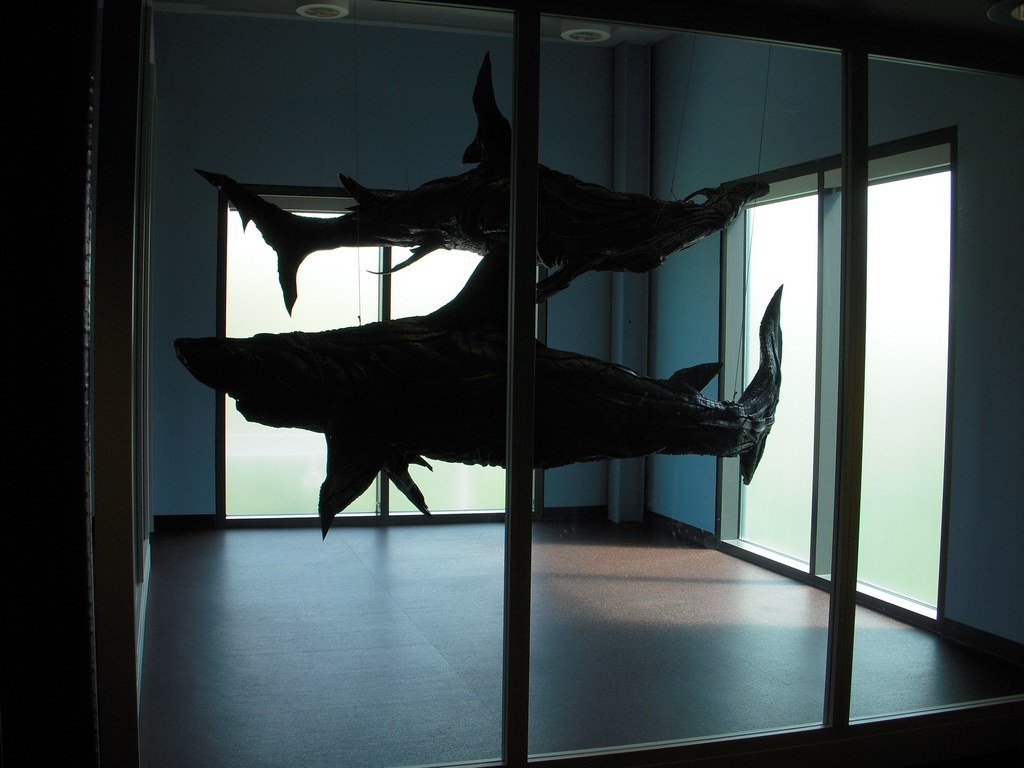
Yong Ho Ji, Shark tank at SEI. They built the tank and installed frosted windows as part of the piece.

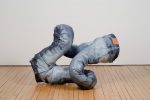
Also hanging in one of the big sunny atriums were Norm Paris‘ installation of Michael Jordan trying to save the world from nuclear war, Tristin Lowe’s great big slingback chair (a prop waiting for a movie), and, around the corner, the Dufala brothers’ Ice Cream Truck.  (See the artists of the West Collection here.)
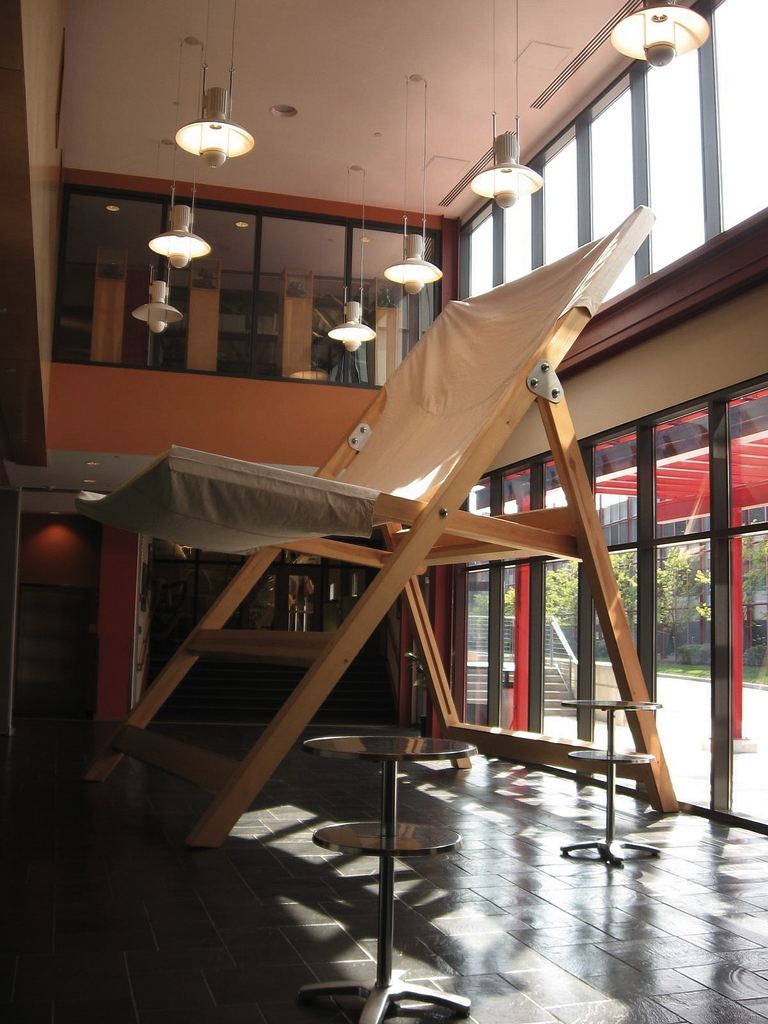
Tristin Lowe, Folding deck chair, 2004

It’s always amazing to see all this crunchy art in the workplace and to hear Stoetzel’s stories about the joys and tribulations of having your art audience so close to you. This year, he said, he had several people who were so into the art that he was letting them curate their own show for a hallway near their work area!
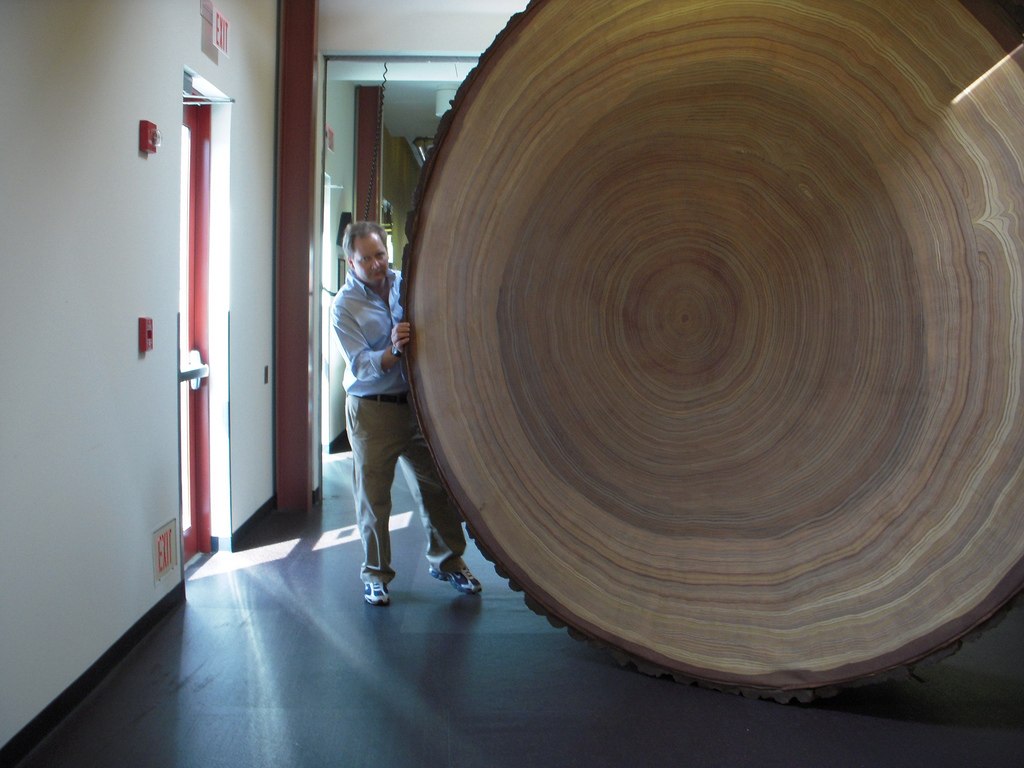
Sharon Levy, Cookie, 2007. Faux tree trunk made of painted canvas and foam. Lee Stoetzel moving it into place in the finalist's show.

The West Prize is in its second year of purchasing $10,000 of the work of 10 emerging artists and awarding a $25,000 cash prize to one of them. It bears mentioning that the competition was created as a response to the recession’s very big impact on the collection, which forced them to cut their art buying and limit it to an annual $125,000 budget. Still and all, what an opportunity for an emerging artist–the finalists get recognition, get collected, and get some dough. Plus their work gets seen by an engaged public–the employees of SEI.
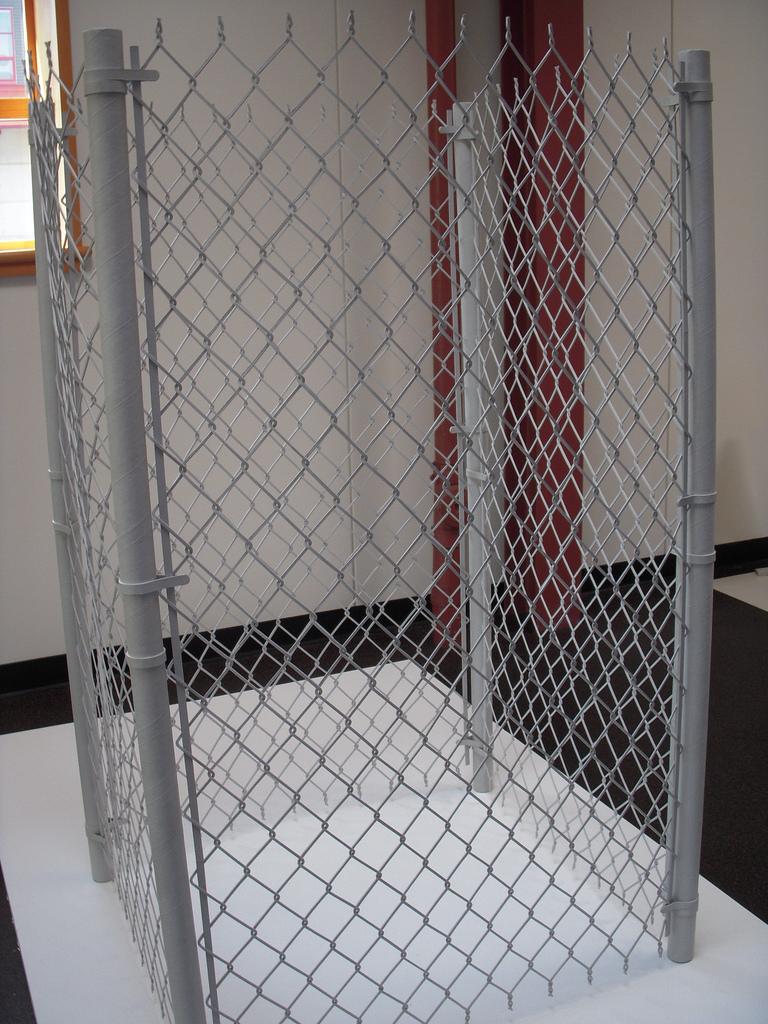
Leah Bailis, Fence, 2007. Finalist for West Prize. Fence made of paper and cardboard.

It’s too early to tell whether this new, lower-cost approach to acquiring art for the collection will change what’s being bought.

What has changed is how Curator Paige West and Stoetzel review work. Instead of going on studio visits and seeing art in the real world they now jury from electronic submissions made to the website. We’ve all looked at jpegs and then seen a piece in the real world and had that “aha” moment when something–the size, the color, the texture–becomes clear that was not clear in the jpeg image. It’s a very different way to look at art, and we wonder if in the long run two-dimensional work will be favored over installations or large sculptures, which don’t always show well in jpegs.  Time will tell — among this year’s finalists are four artists who make sculptural installations.

We are still in a recession and the West Prize show (on view now — make an appointment with Stoetzel to see it) did look a little bit wan and tamped down. Actually, we’ve seen a lot of “wan and tamped down” of late.  That could describe the Whitney Biennial and all the art fairs we’ve been to in the last 6 months.  It’s the economy baby — the art world is depressed.

The 2010 West Prize winner
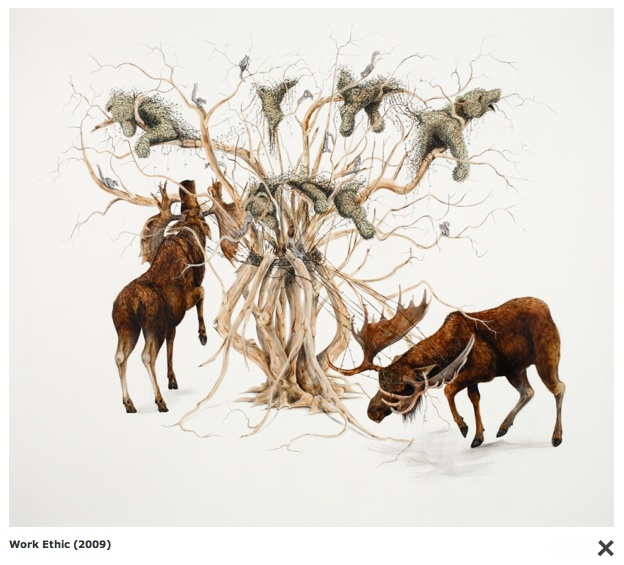
Ryan McLennan, Work Ethic, 2009. Photo from West Collection website.

The winner is Ryan McClennan, whose drawings are big, pristine and illustrational. They posit a world of endangerment where everything in nature is a mess. The pieces we saw are virtuoso drawing, but both the concept and the oceans of white space denoting the void are pretty expected in 2010, reminding us of other white-background kids like Marcel Dzama and Ben Peterson.
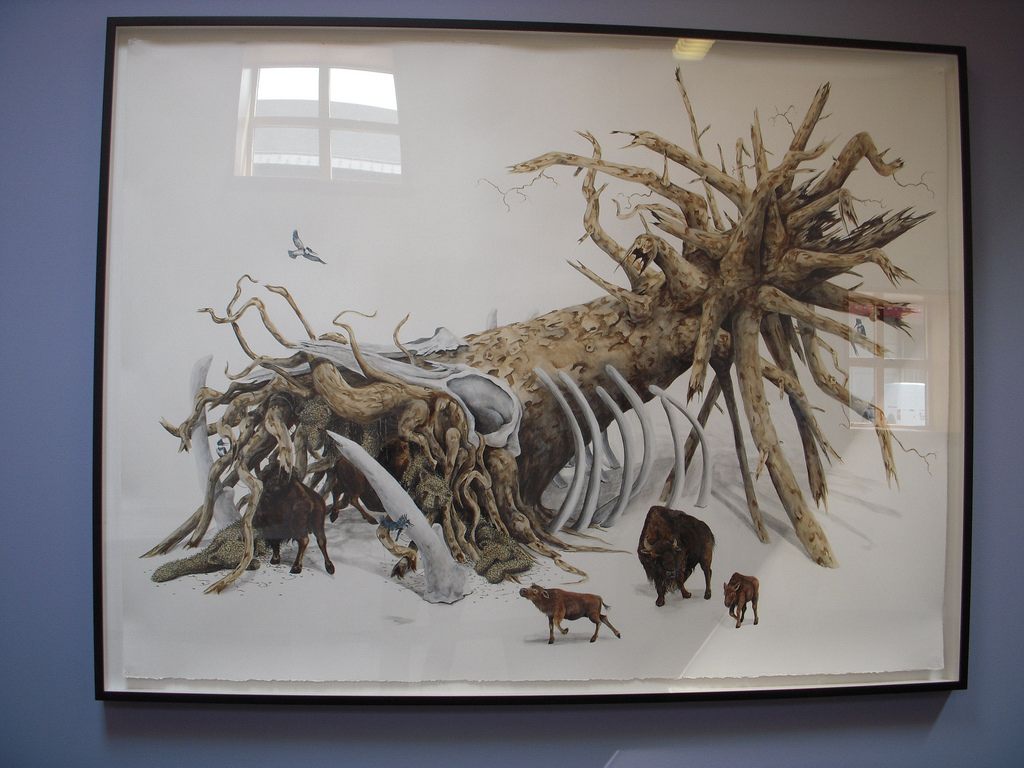
Ryan McLennan, another piece on view in the finalists show

Last year the $25,000 prize went to the Dufala brothers for their Ice Cream Truck — a truly wild piece of art and a risky choice for the winner, both because it conflates ice cream, childhood, capitalism and war, but also because it’s a rough-around-the-edges piece that is anything but beautiful. Prizes are awarded for many different reasons and speculation is pointless. While we were impressed that the prize couldn’t be typecast as going for only one kind of art, we thought this year’s choice was less risky than last year’s — although it sure does affirm certain threads running through the West Collection — like their interest in art about the ecological mess we call earth and their consistent love of finely-crafted and beautiful drawings.
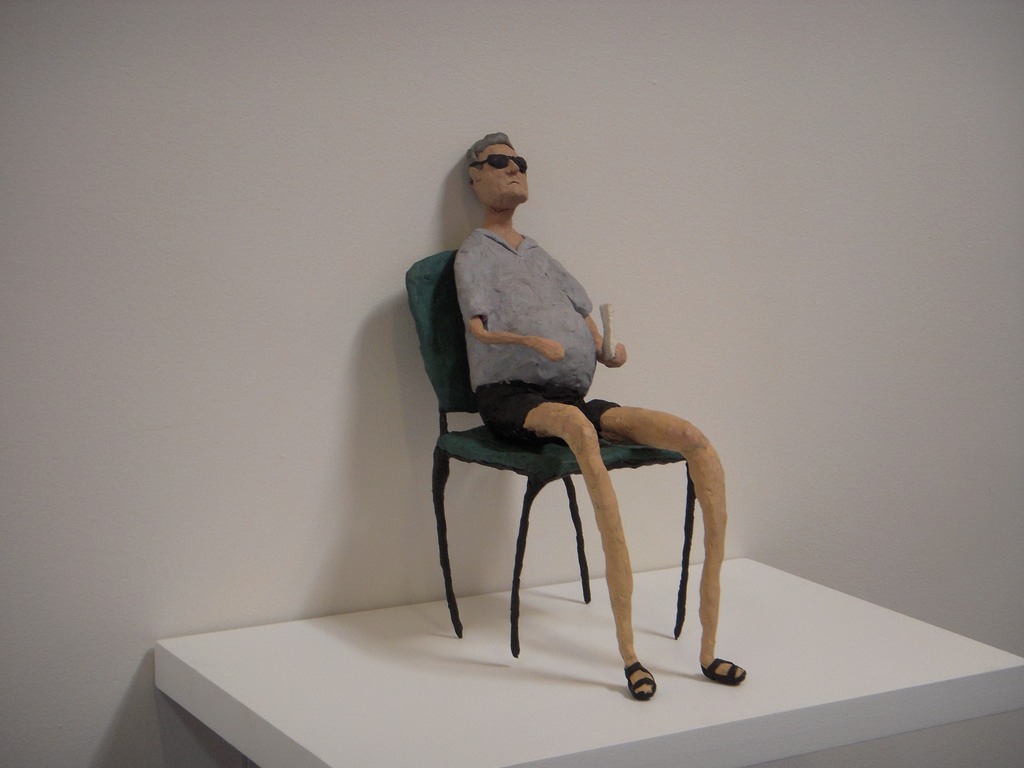
Revital Falke, plasticine figure in finalist's show

If they’re going to collect in depth (something the West Collection is noted for) we’d like to suggest they buy more Revital Falke. This artist is a surprise and frankly we hadn’t seen work quite like hers before in the collection.  Not only does it play with cartoons and pop culture but it has a kind of outsider’s obsessive take on things.
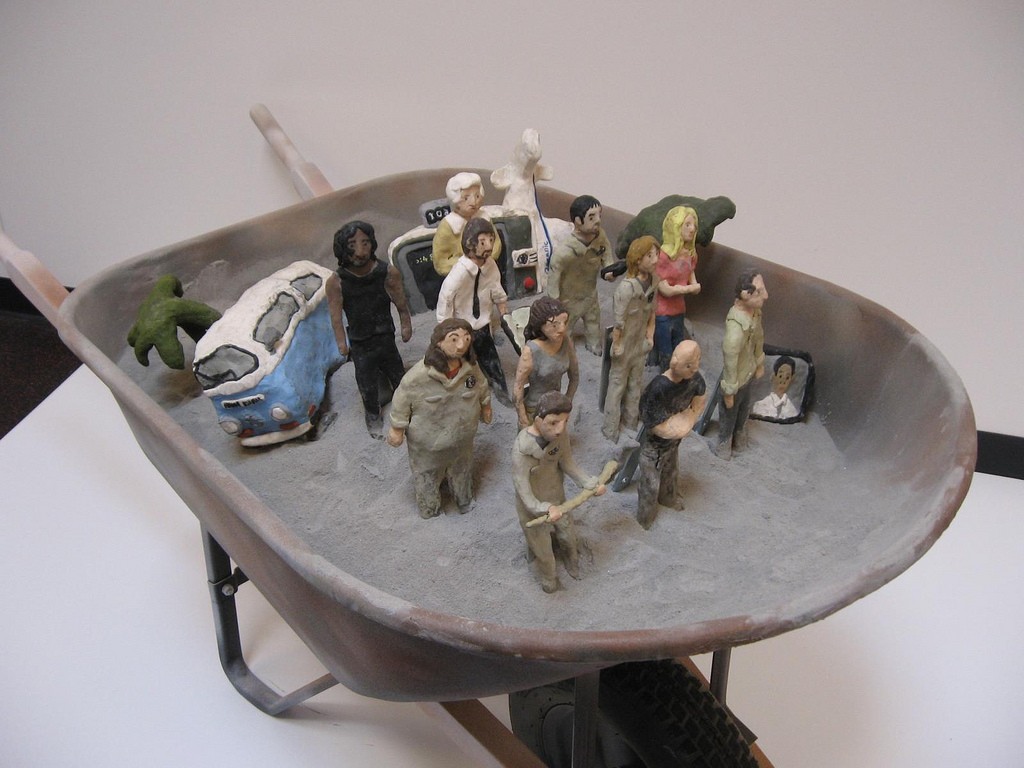
Revital Falke, from the "Lost" TV series

Revital’s plasticene pieces mix the utterly believable with the utterly unlikely. She took this wheelbarrow, a scenario from the TV show Lost, out on a beach somewhere and allowed people to touch the figures, Stoetzel told us, giving random people a kind of authorship of the piece. Stoetzel told us they thought that was really special and we agree.  Falke’s interest is in the everyday.  Bringing the Lost characters into the real world on the beach makes them lost — and found — without losing their Lost-ness.  We love that.
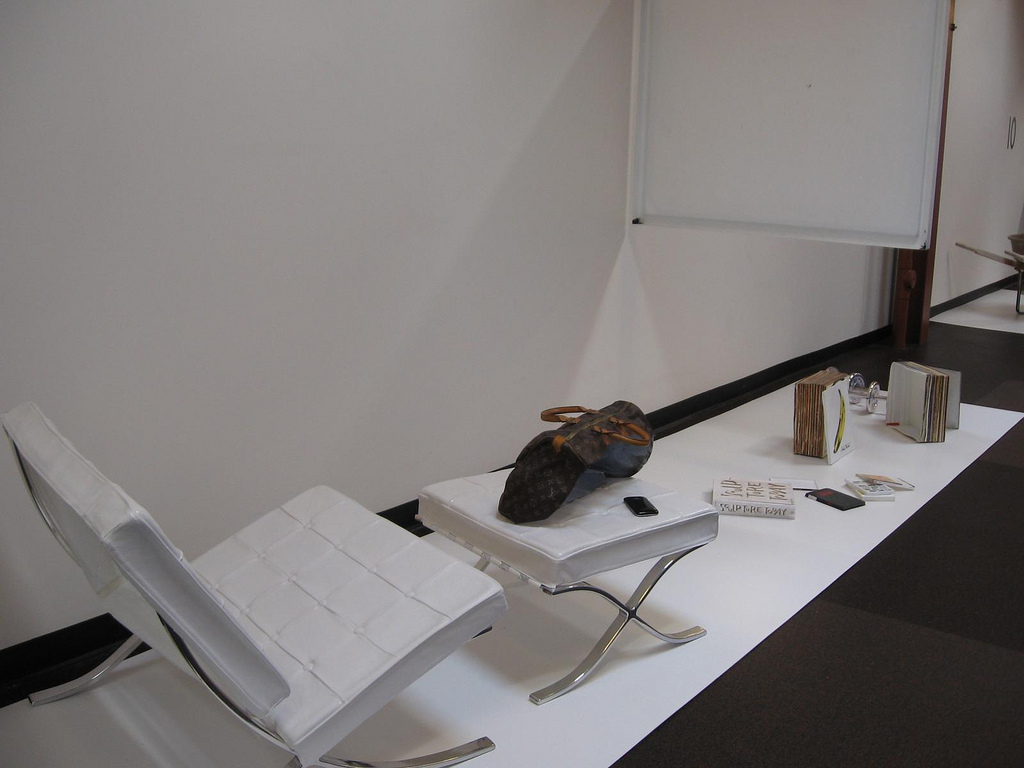
Miyo Yoshida, Books, detail, 2009, styrene, paint, vinyl, paper, dimensions variable.

Revital is one of seven women in the final 10 this year. The others are NaTalica, Leah Bailis, Sarah Kabot, Sharon Levy, Julie Weitz and Miyo Yoshida. The men are David Almeida, Kevin Cyr and McLennan. This mix is an unusual state of affairs and bespeaks getting beyond mere tokenism for the ladies. While we’re working the stats, three of the artists live and work outside the U.S. (in Italy, London and Israel), two live and work in Florida, and one (Bailis) is from Philadelphia. The winner, McClennan, is from Richmond, Va.
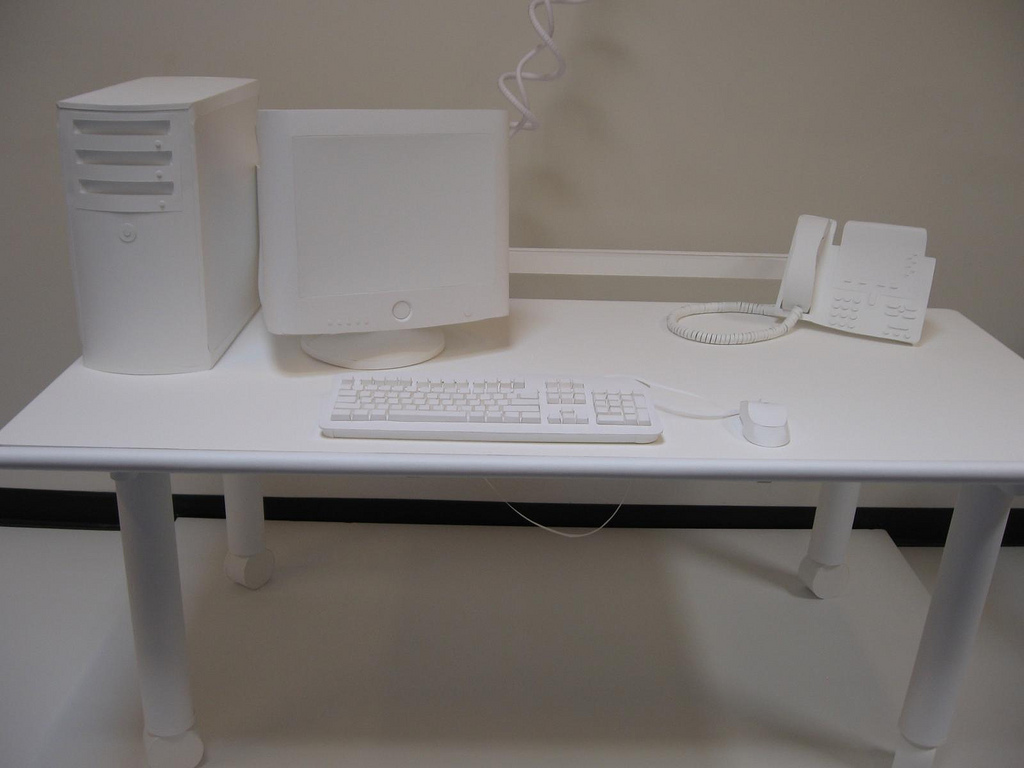
Sarah Kabot, detail of a life-sized paper replica of an SEI workstation.

The exhibit favors trompe l’oeil–trompe l’oeil sculpture and trompe l’oeil drawings. Trompe l’oeil is a delight, in and of itself.  And the collection is strong in it.

The exhibit also favors tight and white, as in crisp, clean lines and no floppy, sloppy workmanship and blindingly blanche neige color schemes. David Almeida‘s C-prints of dime store replicas of natural objects are pristine, Audubon-like taxonomies on white backgrounds. Sarah Kabot’s white paper sculpture of an SEI Corp. work station — it could be a workstation from anywhere — is a ghost of a thing.

Leah Bailis's iceberg of a house (l) and Adam Cvijanovic's iceberg mural.

Leah Bailis’ suburban house fragment is iceberg-ian and situated nicely near Adam Cvijanovic’s iceberg mural. Julie Weitz‘s paintings of guys (or girls) in scary balaclavas feature voids of white space behind them — kind of like blowups of catalog items for sale at a hipster LLBean.

Anyway, congratulations to McLennan and the other 2010 winners, and keep on applying all you artists out there!  The prize will continue next year.  And congratulations to the West Collection for supporting — and continuing to support —  emerging artists.

More photos from our visit at Roberta’s flickr and Libby’s flickr.
Tags: , , , , , , , , , , , , ,


Readers Comments (16)

  1. Allison Hunt says:

    Thanks for a great post!

    This is a really interesting prize. Knowing the strong reputations of Paige West and Lee Stoetzel I don’t worry about their ability to evaluate online submissions. They are astute, established and well-qualified, and this approach certainly lets them see more applicants, which is hugely beneficial to artists around the world.

     
  2. I hope for more collectors and institutions like the Wests/SEI.

     
  3. libby says:

    Somehow, Philadelphia has failed to create a community of risk-taking collectors who will buy in Philadelphia. Without that, there’s not enough of an art market here for the galleries. I just wonder what that would take to make it happen.

     
  4. Ben says:

    Thats the heart of it Libby. A hand-full of active, well-informed collectors could singlehandedly change the landscape of the art scene. (See Saatchi on a much smaller scale) A number of Philly collectors are confused as to who to listen to when determining what art to purchase. With things like the West Prize, the Pew, the Fleisher challenge making safe choices both in the art they champion and the judges they choose, it makes it that much harder to push risk-taking artists careers. I think the West Prize is great but its seems to be heading in a very safe direction which excludes large segments of the art thats being created today.

     
  5. roberta says:

    We need to educate a new group of collectors, and not just “young collectors of the PMA” or whatever that is. And we need somebody to undertake a shuttle bus to get people around to the hinterlands where the great risky stuff is taking place. Surely there’s some group somewhere that could help out with that…we need a Bolt Bus mini that makes stops in Kensington, NoLibs and Frankford!

    I do think a biennial could help with the education if it’s done well. We need to create a big public buzz about what’s here and what’s good. And there needs to be programming around it that’s friendly–bring the kids in. It sounds lame but the Whitney Museum has kids programming for the Biennials. It’s important!

    Inliquid’s Art for the Cash Poor has always been a good little art fair…Art Star’s craft bazaar too…People go to those–there’s a big audience. But those are not curated shows and there’s no sense of whether the works are good, bad, or otherwise. Maybe somehow somebody can spin off a curated show from these little art fairs and start things that way. Here, you like Art for the Cash Poor? Try Curated Art for the Cash Poor with special talks by curators and a great juried roundup of art (not only from the fairs, maybe not from the fairs at all…???)

    Philly doesn’t have a huge base of monied folks. I’m thinking of Miami, which does, and which has several private collectors who have created museums and what that’s done for the city (even before the art fairs were there the collectors were already there and collecting). We have only one private museum, the Barnes, which is really not private at all but started out much like the Rubell Collection or Margulies or World Class Boxing. The Wests once were talking about creating a museum for their collection. My guess is right now a West Museum is on the way back burner. And here’s something — the Wests didn’t always collect Philadelphia art. They were very New York in their buying approach. That changed several years back and they’ve been very pro-actively Philly since then. But they don’t collect only Philly artists. And that’s what we need more of too. People who collect Philly art–and art from elsewhere.

     
  6. Ben says:

    Those are all good ideas Roberta. However, a large majority of collectors or possible collectors need to be told what to buy and why. I don’t think seeing the work is enough. The few collectors that are around purchase a lot of stuff that I wouldn’t even consider contemporary art but call themselves contemporary collectors. Its very hard to convince these people to change their buying habits when the institutional framework in Philly doesn’t support work thats challenging. Don’t get me wrong, things are getting better but there’s a long way to go and I guess I’m a sucker for a challenge.

     
  7. roberta says:

    Ben, I agree that it’s really frustrating and that people need more than just seeing the work. But seeing the work is a place to start. It seems, in fact, a good place to start. I also agree about institutional support. PEI should start a new branch on their family tree that involves educating collectors because “Educated collectors are an exhibition’s best customers” (to paraphrase Syms)!

     
  8. Ben says:

    Educating collectors would solve the problem, I just don’t know how a non-profit institution could legally fund that sort of education. Plus, I definitely wouldn’t want to be the one that would have to organize such a group. Thats a nightmare. I may be thinking too black and white about the legality issue but it seems sticky.

    I think the easiest thing to happen would be to get a few curators to write a paragraph or make a list of local artists that are really doing interesting work. Put it on a blog and let people like me refer to it and debate it. I’m not sure if Philly artists are ready for that type of transparency but I for one would. However, that would require the big curators to actually go out and see more shows. In short, someone has to put their money where their mouth is (so to speak).

     
  9. roberta says:

    Hmmm, a list… we already have a list–the Pew Fellows. There’s plenty to debate in that list. Maybe someone should start a blog with that list and add names to the mix and ideas about lists and prizes/fellowships in general. I don’t know.

    As for a non-profit educating collectors, why not? There’s no reason I can think of why PEI couldn’t, for example, add an educational requirement to the grant application. Educate children in the daytime with hands on workshops and educate the parents in the evening with wine and cheese seminars where a curator of the show talks about the art. How hard could that be? And that’s not a conflict with non-profit anything. It’s educational. We all need to think bigger and think more positively. Your own gallery could host educational events and get the ball rolling. Charge a few bucks for the wine/cheese and get a curator to talk about contemporary art. It would be doable. It’s got to start somewhere. SOmeone’s got to break the ice.

     
  10. Ben says:

    If the PEI is OK doing it, I have no problem. I think that’d be great. I guess I was thinking that non-profit status was a little more stringent than maybe it is. Sarah and I have talked about doing something similar. Its in the works. However, I’m just not sure how effective it’ll be. Esp. considering we’re selling work all over the US but not in Philly. As for the list…I want to hear what all the big curators in town think. I wish there was public pressure to force them to pay attention and put in writing local art they like. That list could then function as a resource that a lot of potential collectors seem to want. Apparently, my word isn’t enough. Ha.

     
  11. roberta says:

    Ha is right. A curator’s word is pretty much golden but curators are also a little after the fact in some cases, going with what is safe. I’m glad to hear you and Sarah are going to do something yourselves–that’s the spirit! I’m also glad you’re selling!! Even if it’s not in Philly. I believe Shelley Spector had similar experience when she ran Spector Gallery.

     
  12. Ben says:

    Side note….Here are two exhibitions from elsewhere that are possible models for the ‘biennial’ idea.

    http://escapefromnewyork.tumblr.com/
    http://www.independent.co.uk/arts-entertainment/art/news/ybas-the-next-generation-on-show-1954217.html

    Others are most definitely doing things…don’t know why we are not.

     
  13. roberta says:

    Great links! Libby and I know Olympic Lampert, curator of Escape from NY…somebody needs to talk with her–she has great energy and a good eye and knows the NY scene really well… Also I like taking the show on the road, as in the UK show which will travel to 4 locations. Money makes it happen. It would be great to see how the Escape show got funded and likewise the Independent show. (is it funded by the Independent newspaper–I only looked very quickly). also, I love the Escape blog! Maybe someone should start a Philly Biennial blog with pictures of possible spaces and with pictures of possible art…would it hurt (feel too exclusive) or help the discussion?

     
  14. libby says:

    I want to take issue on the people with money front. There are plenty of people with money. Many of them live in the suburbs and are afraid to come into the city, let alone purchase art that’s on the edge. Where’s that damned shuttle bus? That might take away some of the difficulty of sketchy neighborhoods and widespread art venues.

    Also, since Barnes got mentioned, I want to say he had advice, had people taking him around, showing him what to buy. That’s how people can buy edgy and still have some sort of safety net. Also, if you’re buying very edgy and raw, you’re not plunking down the big bucks. All you need is a few winners to overcome the mistakes. It’s not that different from risks in business.

    Philadelphia’s red hot art scene hasn’t really penetrated John Q. Public’s minds. It takes time to establish cred. So we may know what wonderful things are going on here, but there are hundreds of thousands who haven’t a clue. At some point, the tide will turn, I hope, and people will recognize that what’s here is amazing. But as the local galleries get wider-spread press, international gigs and internet presence, this should happen.

    Ben, I’m very excited that you are planning some sort of education/tour kind of thing. And thanks for the links to Oly’s project and the UK show. All paradigms for Philly’s cooking pot.

     
  15. Ben says:

    You’re right Libby, there are enough people with money to make a huge impact on the Philly Art scene. And it is exactly akin to any risk assessment for business. Although, banking on art as an investment can wholly curtail any collection and should be avoided at all cost! There is also a good deal of money that goes to really bad, outmoded art. That actually isn’t the problem. The problem, like you eluded to with Barnes, is that someone is telling these collectors to buy bad work. Then when said collector realizes the folly, their opinion of the entire Philly art community is soiled and that collector will only buy in NY. I wish Sarah and I could convince more collectors to pay attention and purchase here but lets keep in mind we’re competing with PAFA, PMA, ICA, etc. ie. I was told in an email very recently “…I really like that piece but I gave to the PMA this year…”

     
  16. Jennifer Zarro says:

    Sorry if I missed it, and for my ignorance but Ben, could you tell us what gallery you run?