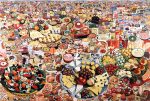

national

Unmonumental at the New Museum (NYC)

By

February 26, 2008   ·   13 Comments

Photobucket
Ugo Rondione’s Hell, Yes! graces the front of the new New Museum.

Unmonumental investigates collage in contemporary art practices and it does so by turing the exhibition itself into one large collage. The outcome is just as confusing as it sounds like it should be.

I supoose the ideal way to have viewed Unmonumental was to visit the museum three times. First, when Unmonumental: The Object in the 21st Century opened on December 1st and the galleries hosted only the sculptural assemblages. Then it might have been a treat to re-visit when Collage: The Unmonumental Picture was added to the walls on January 16th and less over-stimulating when The Sound of Things: The Unmonumental Audio took the airwaves on February 13th.

Videos were added to the collage on February 15th as part of Montage: Unmonumental Online which doesn’t seem as overwhelming because you have the advantage of knowing that you don’t have to take it all in at the museum, but can view all of these projects while browsing Rhizome.org in the relatively stress-free environment of your own home. (I suggest works by Michael Bell-Smith and Kenneth Hung.)

Stand-outs (to me) in the exhibition are:

Sculpture: The always awesome Rachel Harrison (with exciting assemblage seen below), and Gabriel Kuri who I believe made some neat sculptures out of two wire garbage cans with stuff caged in between (one of the “stuffs” was a bit of plastic in rainbow colors).


Rachel Harrison

Collage: Actually a lot of the collage was pretty cool, and to me works on paper are pretty much the essence of “unmonumental”, especially on so small a scale. I was pleased to be intoduced to the work of John Stezaker and Martha Rosler.
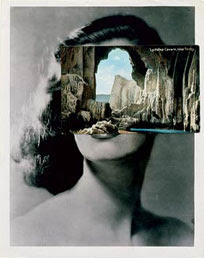

John Stezaker


Martha Rosler

Audio: I can safely say that I digested none of this. Totally my fault as I found myself flying through the museum at top-speed. It was like I couldn’t concentrate on anything.

I am left wondering if it is now heroic to be un-heroic. I am left wondering what un-heroic means. I feel as disjointed as an assemblage. Calling this show inspiring is a bit like calling this exhibition monumental. It’s a survey of a state of mind. It mirrors the complexity of every-day existence. I don’t suggest a trip to the New Museum if you are trying to run away from your problems.


Part of Young-Hae Chang Heavy Industries’ Black on White, Gray Ascending (2007) as seen from the food service.

I did enjoy the piece by Young-Hae Chang Heavy Industries in the lobby next to the food service, and I suggest bi-passing the whole “paying for a ticket to see the show bit” and just hanging out there for free. But you can also enjoy some of their projects right here (THESE GUYS ARE AWESOME!!!!!!!!!):

DAKOTA

THE SEA

ALL THE REST.

So why leave the house anymore really?

Roberta Fallon covered the Unmonumental opening earlier, view that post here.

Tags: , , , , ,

13 Responses to “Unmonumental at the New Museum (NYC)”

  1. Anonymous says:

    I found the show underwhelming – a lot of “sound and fury signifying nothing.” Urs Fisher’s pieces stood out, as did the Young-Hae Chang Heavy Industries piece. I want to see the museum be more than just a stack of white boxes. The exterior is pretty cool.
    Stephen

  2. Anonymous says:

    I couldn’t wait to get out of there. A few interesting pieces, but a great many that future archeologists will accidentally throw away without realizing they are chucking the art. The piece you note by Rachel Harrison was the one that really got my gag reflex going and started me on a rant that might last a few more days yet.

  3. Annette Monnier says:

    Gee. I really, really, like Rachel Harrison and thought she was one of the better artists shown. . . I don’t gag too easily, but agree with you for the most part. I would be interested in hearing your rant.

  4. Anonymous says:

    Ok, well, here’s a snippet…

    My comment about future archeologists sort of says it. I’m an art lover through and through, but I don’t want to have to study the canon of self-referential art school drivel to get it.

    Pile up some wooden chairs, throw down a plastic drop cloth, or lean a broken old bike with a picture on it against the wall inside the hallowed halls of the new museum and it is relevant; elevated by context and 30 years of chain-linked references.

    Take that same broken down bike, pile of chairs, or drop cloth and put them on the sidewalk outside the museum and no one would notice them. Except for maybe an aggrieved street vendor hoping the trash truck would hurry up to clear off the sidewalk so he could park his hot dog cart.

    It’s art because the New Museum curator says so, not because in any other context anyone could know.

    I’d love to do a TV game show called “pick the art.” I could take two made up things and a curated piece of art all together in a police lineup and let every day people and experts alike try to pick the art. If every day Joe did pick the art, I could offer to let him keep it or take a fresh $100 bill…

  5. ben says:

    I must wholeheartedly disagree with you ‘anonymous.’ Your very reaction against these works attests to their success. If a work of art made you question if it is actually art that you were witnessing, I would call that provocative and thought provoking. In the present post-deconstructive world that we live in, what would better exemplify the disjointed nature of our present environment? I certainly don’t think that a snappy factory made Koons or Hirst or any object closely resembling a product is worthy of being representative of a sense of existing in the now.

  6. Annette Monnier says:

    ( To my dear friend Anonymous) As an art lover I find it hard to believe you’ve never had an “aesthetic break-down” while looking at trash on the street, to be perfectly cheesy, sometimes I find trash so beautiful that I want to cry. I wonder why we even have art museums because the natural stuff that happens can be so beautiful.

    Also I don’t think artists “just lay down plastic and chairs” I think that decision comes from a long thought-process and that most are trying to make something transcendent and beautiful. I think this has nothing to do with books and art theory.

    What about, like, Duchamp? You can’t hate him can you?

    But I really like your opinion about the books, it’s okay not to like stuff just like it’s okay to like stuff–and you’re right about the curator but don’t forget that the artist had to call it art before it ever made it to the New Museum.

  7. Anonymous says:

    @ben: If by reaction you mean my “I’m not going to come here again” thought as I left, how does that make it a success? It didn’t provoke any thought at all other than “these people must think we’re all idiots.”

    The very fact that you need to use newspeak like “In the present post-deconstructive world that we live in, … disjointed nature of our present environment?” to express your point of view, just makes my point for me.

    I’ve seen art that stopped me in my tracks, art that made me think for days, art that brought tears to my eyes in the gallery, and art that made my smile from something completely unexpected, art that I didn’t realize I liked until a year later,…. There were some moments like that at unmonumental (e.g. the collage faces) but the pieces I mention did nothing. I looked at them with an open mind (but sans bullshit decoder ring) and they just sat there with nothing to say, a testament to our collective willingness to fall in line and accept a disconnected-from-reality, self-referential, navel-gazing form of art criticism.

  8. Anonymous says:

    @Annette: Hmmm… how to respond…

    Yes, absolutely I have “aesthetic moments” in all kinds of unexpected places, though to be perfectly honest my range rarely extends to trash. For example, I respond to Chris Jordan’s photographs of monumental abstractions (piles of dead cell phones etc.) but don’t find anything in Irving Penn’s pictures of gum, cigarettes etc. on the street. Just a taste thing I guess.

    And no, I don’t hate Duchamp (I don’t hate anyone), but what he started with his urinal and his message that the artist’s intent counts for something is at the root of my complaint.

    I don’t want to have to know the artist’s intent, or the extensive intellectual and critical super structure of interrelated references that his or her intent is built on to “get it.”

    It seems to me that contemporary art runs the risk of just sort of irrelevantly orbiting itself. Art schools graduate artists who make art for other art school graduates; meanwhile, no one else knows what any of it is about because they didn’t get the crib sheet.

    A great glass of wine might be more interesting to the connoisseur because he or she knows the story behind it, but that doesn’t make it any less wonderful to the person who has no idea. Too much art today is like a bottle with a complex story, but without any wine in it (or, maybe it’s more like a pedestal and a note on the wall, with nothing on the pedestal – yes, this is an intentional reference).

  9. ben says:

    I am sorry that you don’t like the way I described this type of work. However, I am not willing to dumb down my description and make no apologies if you don’t like the words that I am using. I could use less descriptive terms but why?
    I must point out that you were the one that commented on this show. It obviously made a impression, even if a somewhat negative one. And our discourse only emboldens my point.
    I am not questioning your love of art. I think thats great. However, I think your fear of some kind of conspiracy in the art world against the general art public is unwarranted. I have yet to receive my decoder ring.
    Lets agree to disagree

  10. Anonymous says:

    @ben: I don’t have a “fear of conspiracy” (those are your words), I just didn’t like the art because I think it relies on complex reference rather than any stand alone “interestingness.” You seem to say that my not liking it makes it successful. I think that is an odd definition of success and sort of speaks to the state of abstraction and odd value systems of the art world today.

    By the way, I’m not asking you speak slower or more deliberately so that a dumb guy like me can get it (though a reasonable person might conclude that would help). I’m pointing out your reliance on reference rather than an actual description of the art itself.

    Well, now that I’ve got this out of my system, what to do now? Surf flower pictures on flickr because that’s what people who don’t know what “deconstructive” means do, or watch that bootleg DVD of Cremaster Cycle III?

    Screw it. I’ll just sit and watch tv. My stories are going to be on in a minute. :)

  11. roberta says:

    I’m going to chime in here just to say that taste is so important in looking at art that it colors everything.

    Assemblage art works subliminally. It depends on the viewer to jump on board and go for that mind trip. I don’t think you need to know art history to do that.

    I like assemblage art alot in general for its ability to let your mind wander. But not all assemblage is good or appealing. Some Joseph Cornell is very unappealing to me. But that’s not to say it isn’t good. It’s a matter of my taste not being in tune with it.

    The works in unmonumental are in a solid tradition of assemblage. The question is are they good.

  12. Annette Monnier says:

    This is RAD.

    Thanks for all your great comments anon, roberta and ben. . . and anon you sound like a real smart guy who knows their stuff but seems a bit aggro. I like that.

    Also, I love art theory, sometimes more then art practice.

    Also, I think the New Museum is, and was, trying something new, and even if I’d rather be visiting the future Murakami exhibition at the Brooklyn Museum I like it when people are experimental (however, not every experiment works out).

  13. Anonymous says:

    Well, after much reflection, it turns out I was wrong and what the hell, I’ll go ahead and admit it.

    My experience at unmonumental simply wasn’t the hi res experience it might have been had I been above the suck line of personal mastery. Sort of like when I listen to Tool but, lacking the aural tools of a trained musician, just think it rocks (but, at least it rocks).

    It simply never occurred to me that that bicycle was in the same “assemblage” genre as Joseph Cornell’s stuff. By the way, I absolutely adore the Medici Princess. I was at SF Moma a few months ago and stood in front of that piece for at least twenty minutes. It is good.

    Oh, also, I never liked the mad max films and I’m afraid that might have subliminally effected my response to Rachel’s piece. Its mel gibson punktum really pissed me off. I’m not aggro, just irritable.

    But this thread was fun; separate from the fact that I got no work done for an hour…

Leave a Reply