
reviews, features & interviews

Weaving the new reality

By

October 13, 2008   ·   5 Comments

Gabriel Kuri
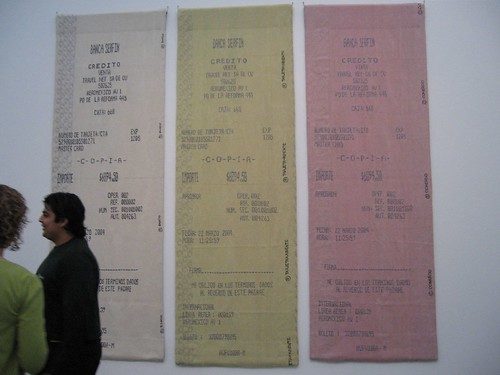
Gabriel Kuri, Trinity (voucher), handwoven wool Gobelin (woven in Guadalajara)

As soon as I saw Ed Ruscha’s Industrial Strength Sleep tapestry at the Fabric Workshop and Museum, this piece by Mexican artist Gabriel Kuri popped into my mind. I had seen it last year at Chicago’s Museum of Contemporary Art, in an exhibit of work from Mexico (post here).

Kuri’s Trinity is a faithful reproduction of a computer-register receipt with the color copies. And it’s handwoven in Mexico, which of course raises issues of the values of hand work vs. computer-generated stuff. At this moment of financial meltdown, it’s a nice reminder of the need to get back to what’s real, all you high-flying wizards of tricky Enron computations and smoke-and-mirrors financial instruments.

Ruscha’s terrific work is a computer-generated copy of something that was hand-made, an acrylic painting of his from 1989 (Roberta’s post here).

This is just a brief observation about what’s going on that I find interesting–the confluence of the hand-made and the computer and the weaving together of meanings– plus deadpan humor.

There are other people working in tapestry at the juncture where computers and hand-work meet. I’m thinking of Lia Cook, who seems to come from a fiber methodology starting point. ( posts here and here)

I was not thinking about Kehinde Wiley‘s ultra-hip tapestry, from Cerealart, which also was digitally produced (in France), but I happened to stumble on it when I put “tapestry” in artblog’s Google search engine. The computer used in Wiley’s weaving process seems to be outside the discussion in that piece, just an artifact of how it got made. Nor was I thinking about the wonderful hand-woven William Kentridge pieces recently shown at the PMA–no computer involved. Those both seem to me to be something else entirely.

Tags: , , ,


Readers Comments (5)

  1. bethheinly says:

    I was informed by Cereal Art that Kehinde Wiley’s tapestry was made in Belgium on a jacquard loom:) I checked it out and considering his work I think that his tapestry fits in perfectly with his motives. Very cool!

     
  2. libby says:

    Hi, Beth, I have no trouble with his motives. I just think the intent in using weaving is different. In Wiley’s work, it is a strategy for making multiples, product. This is not to say that Wiley hasn’t created a beautiful art work that considers the traditions of tapestry. It is wry and funny. The other two, in addition to their imagery, are playing with meanings about this process of weaving and how that very process relates to the message of their work. That is not what Wiley is about.

     
  3. roberta says:

    The Ed Ruscha weaving was made in an edition of 7….I wonder what the price is? probably lower than a one of a kind painting. Definitely product.

    Also, I want to bring Rosemarie Trockel into the flock. She uses computer-programmed knitting machines to make her word and pattern knit paintings
    http://en.wikipedia.org/wiki/Rosemarie_Trockel

    I don’t know whether they’re editioned. But I think Trockel is about the context of the material as much as it is the content of her message.

     
  4. Paul Pincus says:

    love gabriel kuri’s trinity! it’s great-looking…brilliant!

    i also love cerealart’s kehinde wiley tapestry. truly amazing when seen in person.

    cheers!

     
  5. libby says:

    Yes, you’re right about Ed Ruscha and product. Well, all art is product. I like your thought about Rosemarie Trockel. Mentioning her, though, brings to may mind Aryon Hoselton and Alison Macrina’s knit version of plastic bags from the show Hand Job at Space 1026. Here’s a link to your post on it!
    http://fallonandrosof.blogspot.com/2007/03/weekly-update-1-handjob-at-1026.html
    Now that seems to me to be right on the subject!!!
    And Paul, it’s funny, but you wrote “truly amazing when seen in person,” about Kehinde Wiley’s tapestry. When viewed up close, its digital qualities seem to me to interfere with the image in a way that the photographed versions don’t. It’s not that I don’t like the piece. I think it’s great. But I do think that digi look suberts the imagery.