
reviews, features & interviews

Weekly Update — Vox Populi’s Members’ Puzzles

By

December 16, 2008   ·   6 Comments

This week’s Weekly has my review of Vox Populi’s December shows. Below is the copy with some pictures and added words. See Libby’s post for more about the show.

Vox Populi’s December members’ show is a conceptual outing that—with the exception of Amy Adams’ sparse but evocative “Our Boat That Is Made of Flowers”—is totally puzzling.

The newly married Adams is the former executive director of Vox and now works as the director of Fleisher-Ollman Gallery. Her installation is about power, love, war and peace, triggered by her recent honeymoon to Europe where she saw many old paintings of battle scenes and power brokers. Adams’ installation has two parts: a video animation of ocean waves abstracted from a maritime battle painting, and two portraits comprised of words from emails between the artist and her then-fiance.

The animation extracts the ships, smoke, guns and combatants from the original scanned painting and leaves only the waves that she set in motion. Because her source material is a scanned book plate of a painted sea and lacks color, the waves feel unreal – more like a sea of oatmeal than water. But the undulations still invoke seasickness. The idea of a woman editing the Old Masters, grabbing power from the powerful, is irresistible.
IMG_9008 Amy Adams
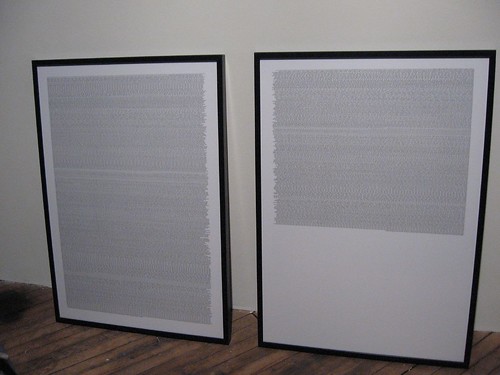
Amy Adams, Our Boat That Is Made Of Flowers pair of portraits of the bride and groom. Photo by Libby.

Adams’ two word portraits, framed and leaning against the wall, are clearly the products of laborious attention to detail. The task of cutting and pasting the words from each email into a “his” and “hers” Word document then sorting the words alphabetically seems an almost crazy thing to do. You can’t boil down a conversation between two people in love to the sum of its parts and have it make sense, can you? Shockingly, the portraits do seem to work that way. The bubbly Adams’ portrait is twice as long as her husband’s and who’s to say that’s not capturing some kernel of truth.

While Adams’ pieces are very straightforward in their meaning, the rest of the show provides a challenge for casual viewers.
Corey Antis
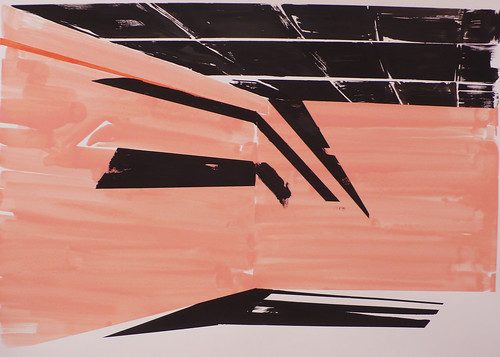
Corey Antis, Herman Street, 2008
Arylic, flashe on paper
18 x 24 inches

Corey Antis’ small works on paper circle the first room. The pieces look similar to sketches, plans or architectural drawings. Washy and with surprising colors—salmon and black in one piece—the series suggests ongoing research. Ultimately, the works are puzzles too personal to be compelling.
Anna Neighbor
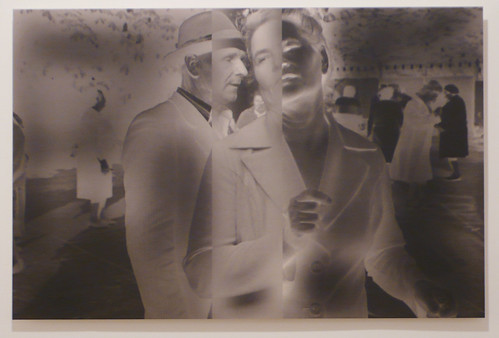
Anna Neighbor, Hold Me Like You Mean It, 2008
Archival inkjet print
33 x 50 inches

Anna Neighbor’s large photo-based works also allude to something more. One photo is almost entirely black. Former Voxers Justin Witte and Olivia Schreiner’s collaboration in the guest gallery is a disappointment compared to their past outings, and Rebekah Tolley’s slow-motion videos projected on objects are reminiscent of lava lamps. Meanwhile, Mark Lewis’ video North Circular in Screening has cinematic chops that create a sense of mystery, beauty, suspense and denouement. (View it at his website).

“Vox Populi December Members Show.”
Through Dec. 28.
Vox Populi, 319 N. 11th St., third fl.
215.238.1236.

Tags: , , , ,


Readers Comments (6)

  1. puzzled says:

    I feel compelled to question the value of an art blog that promotes itself as critical when the chief blogger describes work as puzzling but does not attempt to puzzle it out. Is that not the point of this exercise, puzzling out work? This is not the first time that this word has been leveled against a vox member’s show. In total now four bodies of work in the past few months have been described as puzzling. In each case zero mental effort seemed to have been spent moving beyond this bizarre position. Besides the obvious problem of a criteria for art that all work be readily accessible, and despite the very question of whether this work truly was inaccessible or puzzling, in this review the review went one step further. She warned viewers not to even bothering to go and see the work. It is mystifying why this would be done considering it is quite obvious that the reviewer in question apparently did not seriously look at the work herself (as evidenced by the comment that one photograph was almost all black- my apologies ad reinhardt- when it clearly contained an image of fireworks). One could argue that even without accessing the content of the work both bodies of work contained visual pleasure even for the lay audience, but that is really besides the point. What is wrong with work being challenging or difficult, or obscure god forbid, and what is the point of being a writer of art reviews and if you stop the moment some different art strategy is presented? And what, please tell me, was so offensive in the work that this reviewer felt compelled to warn the readers of the blog and the weekly to stay away. We live in sad and superficial times if this is the level of discourse in our little art town.

     
  2. benwill says:

    Dear puzzled,

    While I agree with your wish that the Philadelphia art community would consistently be more critical, I think phrases like “a disappointment compared to their past outings” and “too personal to be compelling” are steps in the right direction.

    PS. I see no mention in the review of telling viewers to stay away.
    PPS. There’s no such thing as bad press.

     
  3. Anna Neighbor says:

    Hello Roberta,
    I did not write the response to your review, and am unclear why it has been attributed to me. Could you please remove my name to avoid any confusion?

    Best,
    Anna Neighbor

     
  4. roberta says:

    Hi puzzled, I didn’t say don’t go to the show — I don’t know where you got that from and I am very sorry that you interpreted my review that way. I did not mean that at all.

    As for puzzling and complicated, I puzzle all the time–almost everything produced nowadays is complicated, opaque and conceptual.

    When the complicated art doesn’t give me a way in at all or give me something to hook on to–some beauty or ugliness or something that touches a nerve — then it seems like it doesn’t want to talk to me, and so I am inclined to say, ok, I’ll look elsewhere.

    Since I believe art is a communication between artist and viewer I am always looking for that dialog. And when I find it I have lots to say.

    Ben, thanks.

     
  5. puzzled says:

    When you write that the work is not for the casual viewer I don’t really see any other interpretation given the format of the comment. It is a warning. Fine between you and me, but in print, aimed at the city of Philadelphia, it seems as though you are telling people not to go and see the work. That is kind of the job of the critic. This movie stinks, ie don’t waste your money. It is your column your format, but it strikes a nerve since it is the second time you have written this. It might be that you do not like conceptual work, I gleam that but do not want to make any assumptions, but the work in the show is seductive, beautiful, maybe oblique but still visual. I just don’t understand puzzled or puzzling from a critic.

     
  6. roberta says:

    While Adams’ pieces are very straightforward in their meaning, the rest of the show provides a challenge for casual viewers.

    Fyi, these are not my words!!! I get edited at the Weekly. The editors inserted these words, this sentence, this sentiment. It was NOT in what I submitted to them. So I can’t defend those words…I wouldn’t have written them; didn’t write them. I certainly don’t think Adams’ works are very straightforward….and I would not put something in a review to make casual viewers think they should go home (although I’m not sure “challenge for casual viewers” does that — I think you’re maybe being hyper on that point.)

    As for the other times I’ve said “puzzling” about a show, if it was in a Weekly piece, I’d have to go back and look and compare what I submitted to to what appeared ultimately and see if puzzling is what I wrote or what was put in.

    I happen to love conceptual work and if you’ve been reading the blog regularly (5 years) and reading me in the Weekly regularly (10 years!) you will know that.

    But when work does not communicate sufficiently; when it does not give sufficient other stuff, juice, reason for looking besides the concept –and the concept is unclear — I believe that the artist is not about communicating. Art has to have at its base the desire to communicate with an audience. When there is a hermetic quality; when the work could use a Rosetta stone, then it’s not doing its job.