
reviews, features & interviews

Weekly Update – Let’s have a Philadelphia Biennial

By

March 10, 2010   ·   54 Comments

Now in its 75th year, the Whitney Biennial is still the big kahuna—the show every American artist wants to be in and every art lover wants to see. This year, the career-boosting show includes no Philadelphia artists. Instead, the curators of this national show sought talent in Chicago, Oregon, Los Angeles and, of course, New York. They rounded up 55 artists and, for the first time, more than half were women. Reflecting our times of war and global recession, the show is a somber parade, sometimes tedious, sometimes achingly beautiful, with a surprising number of photographers and video artists channeling anthropology á la Margaret Mead. It’s a good show—you should see it.
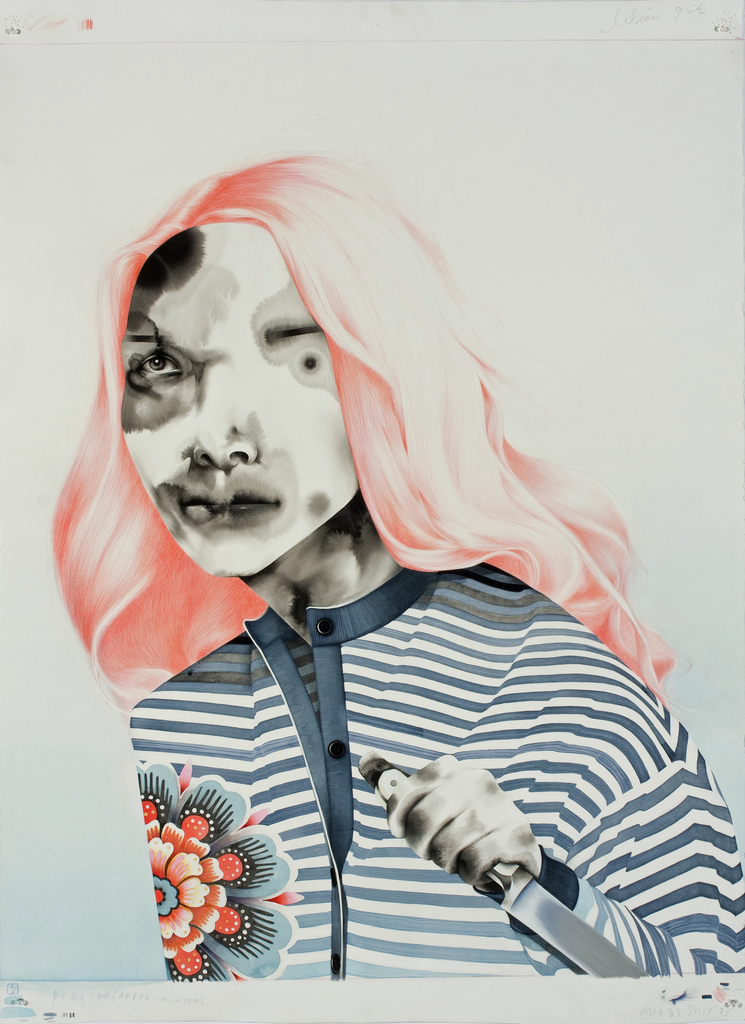
One of several Portland, OR artists in the Whitney Biennial. Storm Tharp, Pigeon (After Shunsen), 2009 Ink, gouache, and colored pencil on paper, 58 x 42 (147.3 x 106.7) Collection of the artist; courtesy PDX Contemporary Art, Portland


But why should you have to travel all the way to New York to see such a high-cailber show? Here’s an idea. Let’s have a Philadelphia Biennial—a large curated show of regional contemporary art hosted by all of our major art museums, organized by museum curators and with a catalog. Though staging a biennial in Philadelphia would be expensive, Whitney’s 75-year track record proves that it can be a lasting investment.

Rocco Landesman, Chairman of the National Endowment for the Arts (NEA), recently spoke at a panel titled “Can the Arts Revive Our Cities and the Nation’s Economy?” Landesman and the other panelists—practitioners from Austin and New Orleans, an academic from Penn and the head of the National Council for the Traditional Arts—all delivered a resounding “Yes, we can.”  (More on that panel in another post. Meanwhile, read Gary Steuer’s post and the Inquirer’s story on the panel.)

The NEA is offering 15 grants of $250,000 to cities (including Philadelphia) to fund bold arts initiatives. Proposing a Philadelphia Biennial is just the kind of move that could win the city that money. PEI (Philadelphia Exhibitions Initiatives, an arm of Pew Trusts) could match that as an initial priming of the money pump locally. But it’s going to take more.

The Whitney Biennial 2010 is sponsored by Deutsche Bank, Tommy Hilfiger, Sothebys, a couple foundations and the Friends Committee of the Whitney Museum. Philadelphia corporations like Comcast, PNC Bank and others could step forward. Local donors and art museum trustees could create a Friends of the Philadelphia Biennial fund.

The exhibit could be at the Institute of Contemporary Art one year; Pennsylvania Academy of the Fine Arts the next; Philadelphia Museum of Art after that. It could be split between the museums and our premier big-box space, the Icebox at Crane Arts Center. There are no rules to break and creative thinking can pull this off.

Biennials, like museum shows in general, are democratic—they are shows for the people. A Philadelphia Biennial would bring the public to contemporary art and educate them about it. In the local art community, people bemoan the lack of educated art consumers in Philadelphia. Buying art is essential to retaining artists here and keeping the arts economy going and growing. Create the Philadelphia Biennial and you will be taking the first step in educating this new group of collectors.

What is needed to make this happen is leadership. Mayor Nutter and art czar Gary Steuer need to get on board and exert political clout. Financial leadership from foundations, the city, universities, corporations and private donors is a necessity.

Who is the audience for the Philadelphia Biennial? It’s the Flower Show attendees—people interested in the city, the arts, beauty and discourse about things that bring joy and meaning to life, that and the thousands of artists, gallerists, collectors, museum professionals and arts lovers in the region.

The Greater Philadelphia Cultural Alliance’s research shows that people in this region spend twice as much on culture as they do on sporting events—and these same people report more satisfaction from those art events than from sporting events. Give the people what satisfies them—a grand, blockbuster contemporary art show to talk about for months with their friends.

If Whitney can do it, so can we. We have the beginnings of a model for this in Philagrafika 2010, the citywide print festival. It’s risky and it’s going to cost money, but the payback could be huge.

Read this story at Philadelphia Weekly.
Tags: , , , , ,


Readers Comments (54)

  1. Yes. Lets.

     
  2. Ben says:

    A great idea Roberta. Its very hard to asses value in a weak commercial market. While this may sound like boring business speak but it impacts the Philly art community much more than people realize. There are many issues to be sorted with a biennial but something needs to happen. I’ve tried to harass gary via his blog about a few of these things and I had an exchange with Joseph Hu about this very subject. Joseph seems to be very much in favor of such an exhibition. The most critical component in my mind is getting the right people to choose the winners. Anyway, these are some of the things that came up at #class at Winkleman on Sun. I hope you can use your pulpit to make this happen!

     
  3. Ben says:

    PS. There are some thoughts here that you might be interested in…
    http://philadelphiaartwake.blogspot.com/

     
  4. roberta says:

    Hi Ben, I think the time is right for a big move on the part of the institutions. Without institutional support it will be hard to make this happen. Corporate sponsors would be great to have but they’re not crucial (see Philagrafika). But without the support of the museums, the many art schools, the foundations and City Hall this kind of big event won’t happen. We had a DIY biennial — Greater Philadelphia — in 2002 at the Galleries at Moore and it was very close to a Philadelphia Biennial. But it was a one-shot deal because it was ad hoc and not supported by all the major art institutions in town. We are deserving of something more — something long-lived and something embraced by the powers that be. I do hope that we can overcome the streak of inertia and cant-do negativism that pervades the establishment here because they’ve got to get over it and take a risk right now.

    A weak commercial market is a good name for what we have. We need a dynamic commercial market. But we need to grow a class of art consumers to make that happen and I do believe a Philly Biennial would set us on that path.

    And thanks for the link to the blog and #class. I tried to see the video of the #class but it wasn’t available when I looked on Monday. If it goes online somewhere can you let us know?

     
  5. Colin Keefe says:

    They’re mostly live streams, so if there isn’t something going on the cameras are off – though occasionally they think to save recordings on the uStream channel. So to watch you pretty much have to go to uStream when there’s a scheduled event.

    As of 4:48 they’re streaming now, setting up chairs for a meeting at 6:15 PM with Magda Sawon of Postmasters:

    “Magda Sawon of Postmasters Gallery will host “Ask the Art Dealer,” vowing to truthfully answer any and every question posed to her as long as it does not involve her weight, social security number or other people’s money. We’re starting to collect questions now, if you post one in the comments here it will get asked!”

    http://www.ustream.tv/channel/live-stream-class
    http://hashtagclass.blogspot.com/

    They do take questions via Twitter, on the #class hashtag.

     
  6. Jaime says:

    Roberta this is a great idea.. Fully support it. I could definitely see a biennial having the same impact as some of the larger art fairs that have been growing for the past 5-6 years, but only more of a cultural level, as well as bringing income to local business. I think the key here, which you wrote about, is involving the city, not one institution, but as many as possible, even with the corporate sponsorship. I think if a Philadelphia Biennial were to occur, and depending on its success, it could spur more alternative spaces in the area, (I’m thinking about how Art Basel in Miami created mini festivals), it could very well be very beautiful addition to the city.

     
  7. berth heiny says:

    Roberta,
    Thank you for writing this post, saying it out loud, obviously, a concept that has been being discussed. Action should be taken. In terms of artists to invite….we should think outside of Philadelphia too. Invite artists from around the globe that are relating to art being made here in Philadelphia. If we are able to create a conversation on that aesthetic level than we would be able to draw viewers from outside too….like the Whitney. This is what artists here really need here, to see how their work relates on a larger scale. Think outside the regional.

     
  8. Perhaps something in concert/complimenting this: http://pifa.org/

     
  9. Ben says:

    Berth,

    I wholeheartedly disagree with the need for bringing in other people. I think its important for Philly artists to be able to stand on their own. An interesting Biennial made up of only Philly artists says an enormous amount for the art being created here and would change the perception of Philadelphia. Plus, I think a lot of the artists here want and need the pressure.

     
  10. berth heiny says:

    Ben,
    When I make art…I’m thinking about art, not Philadelphia. That’s important. The show would have more caliber if we are relating to art and inviting artists from outside our niche. Not to mention, that’s actually what a biennale is….international. (<– ) Don't worry, I'm sure no one will listen to me and we'll have ANOTHER show to see with Philly artists in Philadelphia. And I'm not totally against that, just trying to think bigger.

     
  11. berth heiny says:

    Gierschickwork, you’re on the right site, thanks for the link!

     
  12. roberta says:

    Berth, while I go back and forth on why it should be local only or why it should include people outside the region I do think the model I like best is the Quebec Triennial, a regional show, which I saw in 2008 in Montreal. http://www.macm.org/en/expositions/49.html

    Montreal’s Contemporary Arts Museum put the show together over 3 years; decided to show 38 artists and had 135 works. It was marvelous, great–better than many Whitney Biennials — and it was regional. But it didn’t come together overnight. The organizers worked hard and picked the best and the artists rose to the occasion.

    Since we are making this up as we go along though, there is nothing to say we couldn’t alternate a regional biennial with a non-regional biennial every other time.

    But I like the show as a regional. I do think local artists would rise to the challenge of a big show like this with all eyes on them. The Greater Philadelphia show introduced artists like Rob Matthews, Roxana Perez-Mendez and others to viewers who knew nothing about them (like me). It was a fabulous show.

    Tim, re the “inspired by the Kimmel Center” International Art Fair. It’s happening April 7-May 11, 2011. What have you heard about it? I don’t know anything. And while I welcome the idea I have to believe this is a performing arts festival first with an art component so I am a little worried about what we’re going to get for the visual arts component. This is a one-shot festival sponsored by a $10 million grant from the Annenberg Foundation and run by Kimmel Center folks. I hope to hear more about it. Their website says they’re announcing the full program on April 7. Again, have you heard anything about it at all through the grapevine?

     
  13. Ben says:

    Berth,
    I’m sorry that I’ve somehow offended you by disagreeing with you but your snark is uncalled for. Having been to numerous biennale’s, I have a good idea what they’re about. That said, I’m all for bigger. However in practice how are you going to make sure that Philly artists are given their due? Are you going to tell a high powered NYC gallerist that their artist can’t have the exact space that they want because an unknown Philly artist is using it? Or what about installation budgets or promotion? If we bring in big name artists we are at their whim, not the other way around.

    My point is that this should be not another exhibition but the exhibition. If you’d like to continue this discussion.
    http://philadelphiaartwake.blogspot.com/

    Sincerely,

     
  14. Ben says:

    Tim and Roberta,

    I’ve tried to contact them three times about inclusion in PIFA. They ahve yet to get back to me. At this point, I have very little faith that this will be anything of value for the visual arts.

     
  15. Yes, regarding the PIFA, I have no other information than a nice-looking site, and promises. I have hope though; we’ll see. I’d prefer a groundswell-produced biennial, but it would be good to see some cooperation if the PIFA actually does happen. And Roberta, I believe you’re right about the visual arts being one component. Still, I still think that some type of cohesive vision would benefit rather than hinder…maybe?

     
  16. roberta says:

    Hi Ben, that is discouraging. We will have to see what we get and reserve judgment til we find out. Jaime, I want to say I agree that a serious big show like this could well be an engine of economic development. It would bring money and people into the city and that is good; it would encourage people to come here to join in the art scene and that is good. I know that Miami has benefitted from having the art fairs there. And I do believe the Whitney Museum itself has benefitted in many ways from its biennial show.

    As for regionalism…there are those, including Julien Robson, curator of contemporary art at PAFA, who believe strongly in regional art–art from the fringes; art made in a place that reflects the place; art that is good, great, better than what’s in New York. Julien is organizing a show for PAFA that will round up regional talent (from not just our region but I believe he will include artists from our region) in what sounds like it could be a provocative show and might actually be a great lead in to a Philadelphia Biennial.

     
  17. berth heiny says:

    Ben and Roberta,
    I am snarky, period. Sorry, I sincerely was not trying to offend you personally. I visited the art wake blog. Was interested in some of Colin’s suggestions, like a hotel exhibit. I’m into the idea of regional one year and international another, also, thanks for the link on Quebec’s Triennial. In other news, relating art made here to art made else where will accentuate art made here. Enlarging the scope benefits Philadelphia artists through learning about their work in comparison to other regions while also bringing more people to see it. We are making art in Philadelphia that is unique, but certainly conversing with art being made around the globe. I do not think we need a pat on the back for making art here that’s as good as anywhere, it’s obvious! And “how would Philadelphia artists be given their dues?” That sense of self-entitlement needs to go out the window. As far as where the art goes, I would imagine that would be left to a curator/curators, not the artist. Which leads to discuss who would do this?

     
  18. Ben says:

    OK Berth,

    You’ve proven yourself to be infantile and wholly unprofessional. I think you need to get a better grasp of the reality of the art world. Its a shame that someone in your position must revert to snark to make a point. And here I thought I was dealing with a thoughtful adult. All the best,

    Ben Will

     
  19. roberta says:

    Ommmmm. let’s stay calm and such, please, everybody. : )

     
  20. libby says:

    How is it possible that we’re having a disagreement over something that doesn’t exist, guys. It’s blue sky time, and all ideas are on the table. I’d like to see what PIFA has to offer. But that doesn’t preclude making other plans.
    PIFA looks like it’s quite a mishmash, and my guess is visual arts will get short shrift since there’s no quantifiable gate, which doesn’t mean they shouldn’t do it. However I don’t think it takes the place of an art bi- or tri-ennial. The only way for visual arts is to put on our own serious show.

     
  21. berth heiny says:

    BEN, ur so upset? :( I’m sorry, again, really, really, really. If you put your ego aside, you might notice that I’m not attacking you. It’s true, I’m not wholly. As far as positions and professions go, it’s a free art world.

     
  22. Ben V. says:

    With all of our history, sprawling neighborhoods and diverse communities I like the idea of finding what is unique about Philly and how this could contribute something new to the biennial genre.

    The city, PEI and a conglomerate institutional team tackling one of the huge abandoned factories / warehouses along the waterfront to mount a biennial exhibit could be an amazing investment. Or even taking over one of the monstrous Middle or High Schools for a summer ala PS1.

    I am into the idea of a strong regional focus with a selection of international artists invited to make new work in Phila. I think that Philagraphika, Art in the Open, and maybe even PIFA are paving the way for things to come.

     
  23. roberta says:

    Hi Ben, I love the idea for a waterfront warehouse PS 1-type venue. Now that is real ambition–to clean up and retrofit something old and turn it into a jewel on the Delaware. Let’s get the architects involved too–we have lots of architects and designers here who love sustainable and think those thoughts and build those buildings. They should be brought in on a project like that. Penn Praxis too.

     
  24. Sid Sachs says:

    1. Pifa’s 10 million dollars spent in less than a month scares me. As does the video – the visual arts component consisting of Philly murals and Zagarat. The signage to go up soon at the Kimmel is warmed over Bernard Rosenthal. What happened to the media wall? Isnt the orchestra on the brink of bankruptcy? And using the Rites of Spring as a radical example? (Remember it was only performed by the Ballet Russe 4 times and wildly booed). A CENTURY AGO! Is this only for the Kimmel crowd? The Fringe Festival seems to be a much better model and is working well and growing.
    2. Do we need a Biennial or more museum exhibits with regional components and scholarly catalogs to contexturalize and codify the work? The last time PMA did a real scholarly Philadelphia catalog was in 1976.
    3. Does the Whitney Biennial actually help the artists in it? Have you even looked at the old catalogs? It is a mere blip in history. And the fact that there have been Philadelphia artists in it recently is a historical fluke. Probably bouyed up by recognition from Pew Fellowship winners and PEI panelists/curators seeing the work.
    4. The Whitney Biennial is (inter)national. Why think regional?
    If you do you will start to repeat yourself after a few years.
    The Whitney also has a history, a wealthy board and is in New York. The reality is that we are in the 6th largest city with finite wealth. And Catch 22 a smaller art community/collector base by definition. What does a biennial with the same usual suspects and without a real catalog do for the art market? Doesn’t an (inter) national project that might include a few Philadelphia artists help the region more?
    5. What does it mean to work in Philadelphia? How does that affect the art? What is its history and who has been responsible for any major shifts here? How is significance produced? Can everyone do it together?
    6. Do you actually think the market for art is the same as the Flower Show audience? All those women on the R5 with pussy willow twigs don’t give a damn about art. The Ladies Who Lunch don’t know Ai Weiwei or Franz West or even Nathanael West.

     
  25. Ben V. says:

    Sid, You cut in the right places.

    I think there is much critical work happening in Phila, it just gets cataloged and archived elsewhere?

    When thinking about Philadelphia as a historical medium, my mind immediately jumps to Thomas Chimes, but follows with Janet Cardiff and George Bures Miller installation at ESP, the more recent recent iterations of Oliver Herring’s Task projects at Flux, and the community art project that Pepon Osorio is leading through Temple. Harnessing artists and projects that expands the art community could be a way to establish a regional momentum.

    I can see the ladies that visit the flower show really engaging a large “biennial like” exhibit if the curators and organizers made it clear that they were included as an intended audience. (Many of them feel right at home going to see Picasso, Cezanne at the PMA ect. right?)

    I hear you though…

     
  26. roberta says:

    Hi Sid, I do think the Flower Show folks are the audience. If you ask the Carnegie Museum who their audience is for the Carnegie International they will tell you it’s all of Pittsburgh, and they program for all of Pittsburgh. They have a crunchy contemporary art exhibit and yet they take a very pro-public, pro-education approach to it…and that is what we need here. There is no reason that a Philadelphia Biennial can’t excite the public and rope them in to a discussion about what is contemporary art. It would be great to have more people involved/interested/committed to visual arts and this is a good way to do it.

    I see no evidence that the Whitney Biennial hurts any of the artists that have been in it. Whether it helps is up to the individual artist and what they do with that notch in their belt.

    I don’t think we want to compete with the Whitney Biennial and be international. I love the regional approach taken by the Museum of Contempory Art in Montreal putting together the Quebec Triennial. That show was better than a lot of NY shows…it was all regional artists, none of whom (except David Altmejd) I knew. And I still remember the show and can’t wait for the next one. That’s the kind of show we want.

    We need lots more writing about local art. A catalog for this show is a record of the show and it helps get things documented.

     
  27. Sid Sachs says:

    Anyone remember the regional Biennials at the Delaware Art? Museum? My memory was that they were pretty interesting. But they were driven by Nancy Batty, then the Director. No catalog that I remember. How do we get the PMA interested?

     
  28. roberta says:

    I remember them! they were very good indeed.. No catalogs but tons of Philadelphia artists represented so that they were all but a Philadelphia Biennial. I think the Delaware museum ran out of dough or got embroiled in their capital campaign and abandoned edgy contemporary art shows. Maybe we can get Nancy Batty to talk with the PMA curators. And the head of the Delaware Museum now is Danielle Rice, formerly head of Education at the PMA so she might have some insights at both institutions on how to move things forward. I think the curators are key. You need to convince the curators who will then advocate for a show and help steer the drive for funds.

     
  29. Sid Sachs says:

    And we have lost the Civic Center Museum. They had important exhibitions there randomly. A regional sculpture exhibit sponsored by the Cheltenham Art Center (which was more important than Abington in the 1960s and 1970s), a major Italian exhibit (which contained Clemente’s work for the first time ever), FOCUS Women in the Arts – created by a grassroots consortium of women in Philadelphia and a major early Feminist event covered in Art in America. The Port of History Museum held a major ceramics exhibit curated by the Clay Studio in its infancy etc.

    Using one of the Delaware River piers sounds great. Does the city own one? Could a non-profit obtain one for a dollar a year? Any space(s) in the Navy Yard area (which is totally amazing!!!)?

    These ideas are both exciting and rife with conflicts of interest, territorial fights however. Who is objective enough to create this entity?

    If the schools got involved – how would issues of faculty, alumni cronyism be resolved?

    Since not everyone can participate, who creates, evaluates the selections? With a smaller regional exhibit, within a smaller regional audience, the ratio or percentage of ego bruising would be greater than in a larger less centralized project.

     
  30. Sid Sachs says:

    And the new Barnes Foundation will have a 5000 square foot area for contemporary projects.

     
  31. roberta says:

    Sid, I love the piers…and I love the Barnes thought too. And speaking of the Navy Yard, somebody said Urban Outfitters (based down there) should be a corporate sponsor. That is a really good idea.

    All the questions about smaller regional show, who’s going to evaluate and ego bruising are good ones. I don’t know any answers but it seems to me we have smart curators who could work it out. As for depleting the stock of good artists in one big show and then leaving few for the next show, I’m not sure that would happen…Pew is still giving fellowships after at least 12 years….and there are so many new artists coming to town and graduate artists staying here instead of leaving that we have a big critical mass to draw from.

    The Delaware Biennials didn’t get stale and they went on for many years.

    I think it’s all doable — in spite of the fact that there will be problems and issues. And there is no particular model that needs to be followed, just one that works.

     
  32. I think Sid raises a number of hugely important questions (both practical and conceptual) that suggest a strategic approach to the question of the biennial. What is needed perhaps is a more focused task force of folks from Philadelphia — representatives from the major arts institutions and universities and other funding organizations like PEI along with independent curators, critics, and artists — who can begin to formulate the right questions and determine the desirable objectives for a biennial-like event in Philadelphia. It’s clear from the comments that there will not necessarily be a uniform perspective so there would need to be a rather comprehensive dialogue to establish the range of issues, challenges, and opportunities. As Roberta notes, any such effort would have to have significant support from the likes of the ICA, PMA, etc. who have been pretty absent in terms of supporting local contemporary artists.

    Biennials are pretty odd animals — a dime a dozen — and as an exhibition model perhaps well worn out by now. The biennial has an established but brief history that is intimately connected to the politics of urban “regeneration”, the globalization of art/culture, and the larger neoliberal (free market) narrative of the past 30 years. Perhaps the term is merely an empty container or shorthand that we use, but I wonder if we could do better somehow. It would be interesting to invent rather than follow a 3rd generation trend.

     
  33. roberta says:

    Hi Jeremy, I love the idea of inventing something new rather than following a third generation trend. That seems to me a great premise to begin a discussion with. Maybe your Think Tank as yet to be Named could have a Director of Inventions for the future of Philadelphia arts and convene a meeting? The one thing that needs not be lost, even though it is very third generation, is the excitement of big. It could be a big idea instead of a big show, or a big idea and a big show, but somehow P.T. Barnum got it right — people love a big show.

     
  34. Sid Sachs says:

    I don’t think they ICA has been as absent a supporter of local artists as has been portrayed. The institution’s history had been a lot worst in the (far) past. I think it picked up with Patrick Murphy and has continued to be supportive. It is not just a “regional” institution and I think artists have to realize that they are helped more by institutions that are responsive to their local needs and (inter)national goals too. That is literally the best “SITUATION”.

     
  35. roberta says:

    Libby that’s a great point. Carnegie hires a curator…they stay for a couple years to organize the Triennial…and then poof, they move on. It could definitely work here.

     
  36. Colin Keefe says:

    I have a name for whatever this thing becomes:

    “The Philadelphia Experiment”.

    Okay, there are probably some copyright issues :)

     
  37. Colin Keefe says:

    Here’s why I like it:

    - Philly can be thought of as the heart of the democratic experiment
    - The word fits well with the nature of DIY
    - The word evokes a willingness to try things in a new way

    Why have a Biennial when we can do something more interesting?

     
  38. roberta says:

    Haha Colin! I like it too but yes, copyright issues. Maybe “The Philadelphia Experimental”….?

    I like the idea of doing something new and carving new territory and if there’s a way to get the institutions on board that’s great, but I worry that institutions, which are necessary both for financial help and for their gravitas, are gun-shy of new. A biennial or triennial (the more I think about it the more I like a 3-year ala Montreal or Pittsburgh) is something institutions can get their minds around simply because there are paradigms out there that work.

     
  39. Titles are not subject to copyright. Philadelphia Experiment is great!

     
  40. DRanonyme says:

    Your advocacy for a Philadelphia-based biennial-type exhibition is inspired by all the right motivations, acknowledging the richness and diversity of artistic talent in the region, as well as the importance a thriving artistic community may have for both the cultural liveliness and economic viability of a major city such as Philadelphia. A critic in The Boston Globe has just addressed this same problem (Dushko Petrovich, “How to Start a Revolution,” March 14, 2010), while Roberta Smith of the NY Times has taken on that city’s museum establishment for the narrowness of its contemporary focus (“Post-Minimal to the Max,” Feb. 10, 2010). Something is clearly in the air.

    Although I find your proposal heartening and sympathetic, my lingering response to it was fundamentally (and somewhat pessimistically): “good luck!” Institutional inertia, the competition for resources, ideological differences, and a Balkanized approach to their respective missions among this city’s museums (or any city’s museums, for that matter) are only a few of the most salient impediments to the realization of this idea. Briefly, in addition, here are some of the practical obstacles that would have to be overcome in order to create an exhibition that occurs biannually that could do justice to the diversity of talent in Philadelphia:

    (1) The Whitney Biennial is a national show, drawing artists from all over the map. Understandably, it reflects a NY bias, but that is their prerogative. Nevertheless, the pool of artists they my choose from every two years is boundless if not infinite.

    (2) Alternately, a “regional” show such as you propose is inherently “bounded.” If, metaphorically, the Whitney Biennial has the span of an ocean from which to draw its choices, a regional show in and about “Philadelphia artists” is limited to a much smaller pond. Although new artists are “emerging” all of the time (encouraged by the impressive diversity of first-rate MFA programs in the city), once you move past this forever-replenishing source of new talent, you are left to acknowledge a much more stable and familiar pool of “established,” or “mid-career” artists who struggle constantly for exposure in a city that offers limited opportunity for even the best and most ambitious among them (“ambitious” in the sense that you have to work the system with determination in order to maintain your visibility in the public sphere — and it’s not always the best artists who succeed, or who are predisposed to try). This is where the difficulties arise…

    (3) The Philadelphia art world is certainly no more cliquish, political, or hierarchical than any other major metropolitan arts center, but there is an economy of scale that makes these pockets of influence more visible as a result of its size. You can argue about the dynamics, but as a sociological phenomenon it is an indisputable fact of life (just ask any artist!). The Pew Fellowships in the Arts had, in my past exposure, worked out an intelligent, multi-tiered jury system that deliberately (and wisely) avoided the pitfalls of regional art politics, but nevertheless, you deny the existence of these hierarchies at your peril (I was therefore troubled recently to hear that they had scuttled this system, placing the awards process in the hands of a smaller group of Philadelphia art world “insiders” which, if true, would seem to exacerbate the burdens of politics and provincialism).

    (4) Following from the above, while there are many tested formulae for vetting a regional group show that can succeed in circumventing the pitfalls of politics, hierarchy and provincialism, it is an inherent challenge for exhibitions of this kind to overcome the preexisting burdens of inclusivity that may be grounded in good intentions, but which also have a leveling effect and often contribute to the predictability of these enterprises. This is hard enough for the Whitney to overcome, where the talent pool they can choose from is virtually limitless. As the fishbowl gets smaller, the demands of vested interests — and the need to acknowledge those demands — only increases.

    (5) While the above may be thorny and controversial (even to state the obvious), it is much less so to acknowledge that a city the size of Philadelphia (or Houston, or Chicago, or Boston) includes among its ranks a critical but finite number of “senior” or “mid-career” artists who have “earned their stripes” and deserve recognition as figures of unique influence and accomplishment, respectively through the example of their work, and in many cases also as a result of their influence as teachers. This is less the case in NY, where the opportunities for acknowledgment are much greater. Again, this is magnified in any city smaller than NY or LA. A biannual-type exhibition would ostensibly, over time, acknowledge these artists among the mix of emerging talent that might also be included, but a significant challenge, especially in the short-run, will be how to appropriately represent the breadth of this talent without alternately skewing the selection in favor of “all the likely suspects,” or slighting some of the more worthy of these artists in order to shine a light on younger, less tested talents.

    (6) Finally, though my point here is a bit of a toss-off, you make an important argument regarding the economic benefit that your proposed exhibition would have for the city — though I would argue that the audience for experimental, contemporary art is much smaller than the audience drawn annually to the Flower Show, or the Auto Show, or even the Antiques Show. Nevertheless, it is fair to observe (as Roberta Smith does in the above-mentioned article) that the pressure for commercial success in the museum world of today brings with it an inherent aversion to risk-taking that can (and often does) have a stultifying effect on the entire enterprise. With economics a denominator of your success, there will always be pressure to make safe choices and avoid controversy.

    I very much hope that the idea you’ve proposed takes root and flourishes (what happened, by the way, to the effort perhaps a decade ago to create such an enterprise in Delaware?). My purpose in teasing out these thoughts is not to argue for the impossibility of achieving such an exhibition, but rather to identify some — but by no means all — of the issues that need to be addressed if this vision is ever going to be more than a pipe-dream. My compliments to you for your effort to get people talking. I hope in some small way these comments help to advance the conversation.

     
  41. Sid Sachs says:

    Dear DRanonyme,
    Couldn’t have said it better myself. (If you are still in town – lunch?)

     
  42. roberta says:

    Hi DRanonyme, I do completely sympathize with the “good luck!” comment since Philadelphia (institutions especially but people as well) does tend to be hidebound and stuck in its ways and inclined to say “no” instead of “yes” at every opportunity.

    And all your points are salient. A regional show will absolutely be bounded by the region. However, it doesn’t seem to me an insurmountable obstacle. The Museum of Contemporary Art in Montreal just began a regional
    triennial which I saw in 2008- it was one of the best group shows I’ve seen. Regional talent, better than NY. It took the MCA 3 years to put the show together. And I believe they used rigorous standards for selecting the
    artists. I think we could do something like that here too … and repeat it biannually or triennially.

    As for the cliques, I may be naive but I believe people will rise above petty cliquishness. I can point to the Greater Philadelphia show at Moore College a few years back where a group of curators put on a show very much
    like a Philadelphia Biennial and it was a terrific show. I don’t think there were heavy favorites that were either excluded or included out of insidery thinking.

    I love your point 5 and I agree that an intelligent biennial would include mature artists as well as up and comers. In fact the Whitney Biennial always includes some “old timers” for context for the younger artists. It’s crucial to have that mix of new and old.

    I agree with you that selling a biennial as an economic engine is a two-edged sword and that safe and successful often go hand in hand in the museum blockbuster zone. But I would point out the model of the Carnegie International, a show run by the Carnegie Museums in Pittsburgh, that is one of the edgiest, riskiest contemporary art shows in this country and the Carnegie Museum programs the show for the city of Pittsburgh. They are putting this show on for the Flower Show folks and the Antiques folks and probably the Auto show folks too. They see it as an opportunity to educate. And indeed when Andrew Carnegie instituted the International that was his intent–to educate Pittsburgh about art.

    While a Philadelphia Biennial would have one difference (being a show of regional art) its greater intent could be the same as the Carnegie International — to educate people about art.

    Once upon a time the Delaware Art Museum had a Delaware Biennial, It was filled with Philadelphia artists and was a really great show. I am not sure why the show ended but I know there have been issues of money at the museum and I suspect that was the problem.

     
  43. Sid Sachs says:

    The Carnegie International as you say is an international exhibit. And it might draw many many people because it is international. The project you are proposing is local or regional. WHY would it draw as many different people if the artists are local producers? The recent project I finished had visitors from Washington, New York, Boston, Baltimore, Virginia, Austria etc and internet inquiries from many more places. IF I had produced an exhibit with 20 local artists (even say 20 of the most famous Philadelphia artists) I would not have gotten that audience.
    It is what the artists say, what the curators do, and what the programming is that draws not the location of the project. UNLESS SOMETHING CAN BE SAID ABOUT THE LOCALE, THE ARTISTS ETC. Who cares about local artists per se, or painters, printmakers, ceramists etc.? It is what those artist do, make, think about and not where they are from and what medium they produce their work in that is what is important. That is why Philagrafika is doomed, why the Fiber Biennial was wrong, and why a Philadelphia Biennial is wrong headed too. Unless you can define a reason what the animal is and why it is needed other than raw ego need.
    Do you want to make stars? Build an audience? A collector base?
    Or do you want people to love, weep, feel, bleed?
    Art was never a mass phenomena.
    How many people were in the Cabaret Voltaire?
    How many in the Independent Group?
    How many saw Happenings?
    How many at the Judson Church?
    At 112 Greene Street?
    Anyone remember Dan Graham at Cheltenham Art Center?
    Or Mabou Mines at Temple?
    Its not numbers. It should be content driven.

     
  44. roberta says:

    Hi Sid, I guess I’m not suggesting that the whole world will be interested in this show. But done well I think the whole region might get into it. The Delaware Biennials were pretty well attended I believe and got a lot of regional attention. They were good shows. That’s an achievable goal. I think we have some great artists here and I think a well curated show could be fantastic.

    Speaking of global eyes on Philadelphia, however, I do want to say that 13 percent of our readership on artblog is from Europe…and we write a lot about Philadelphia art.

    As for the issue of locale etc I agree that locale is irrelevant and the art must be stellar and say something. And sure we want to make people feel, cry, get angry and inspired. That’s the first step in creating a broader audience for art.

    Art has never been less of a mass phenomenon than it was during the last 50-60 years. I think that’s changing, but changing at the fringes where places like Art Star and Etsy make it easy to buy loveable cheap art. Art doesn’t have to be your best friend and it doesn’t need to be loveable. But there’s no reason art can’t get back to being more integrated with the rest of the culture.

    Here’s something. The Cultural Alliance tells us we are a big culture town. Tons of folks go to the dance, theatre,music events etc. Surely all those people could be corralled for an art exhibit in their city that would introduce them to great art they’re unfamiliar with.

    The visual arts scene hasn’t found a way (except for first friday but that’s a whole other animal) to excite those culture lovers about contemporary art. Partly that’s because we don’t have institutions leading the charge…and we only recently got an art czar…and he’s got no money to play with, although I do believe his heart is in the right place.

     
  45. Sid Sachs says:

    You are losing me Roberta. I thought you were talking about art and now you bring in Etsy and Art Star and Cutesie Pie. These fringes are producing cringes. Were you talking about art?
    Do you want to direct the energies of this great city in the right direction?

    I don’t believe the polls at all. If we were such a great art city why is the orchestra in dire straits? Why is Rockie near the PMA?

    The only way that people will notice is if the institutions of note get involved. The museums sanction and codify art. Perhaps a petition should be drafted by artists and sent to all local funders and the city of Philadelphia that no funds go to the museums unless they are responsive to the creative inhabitants of the city. In other words, if they want tax money, they have to represent the artists better. Period. The same letter should go to all the donors and boards in the city. That would be a first step. Then when you have their ears, they might listen to an exhibit or project proposal, might integrate Philadelphia artists into the museum galleries more often etc.

    What would happen if a Philadelphia artist or independent curator selected a gallery or two in the museum from their collection? During the late 1960s, students made an exhibit at the PMA (the entire downstairs and the grand stair area). Why hasn’t there been a Hannah Wilke or Ree Morton exhibit, a show of Hans Haacke’s Philadelphia work, or Rafeal Ferrer? What happened to the Dave Heath retrospective? Why did Helen Drutt’s jewelry collection go to Texas?
    A series on Philadelphia filmmakers at PMA or Annenberg? The legacy of John Ollman on Philadelphia and its collections? Homage to Paul Robeson? etc. etc.

     
  46. Colin Keefe says:

    Roberta said “Maybe an initial town hall meeting for brainstorming where you get some volunteers followed up by work groups to help organize it. Be sure to let us know when Ben has the meeting set up. I know I’d love to be there.”

    - We’re working on it, and will advise.

     
  47. roberta says:

    Hi Sid, I am talking about art but my definition of art is broad. And I’m not talking about quality or art for the ages. I think if Richard Tuttle can put some styrofoam on the floor leaning on a piece of wood and some string and call it art that’s cool. I call it art too. And if some 20 year old paints a picture of a cupcake and sells it on ETSY that’s art too. I don’t like Tuttle very much and I don’t think I want that cupcake picture but I will defend both of them as art. And I think the cupcake painter is doing a lot more to bring people into contact with art than Tuttle is.

    I do believe we need to have fierce curating for this show — by probably an out of town curator (no biases or cliques allowed) — It’s got to be a curatorial tour de force and art historically solid and have really great Philadelphia art in it. We can do this.

    But we need funds. And we need the institutions as you say. Institutional support of local artists has long been lacking. It’s overdue for them to step up. And, I love your idea of a petition! That’s a great idea. Let’s do it!

     
  48. Thomas Del Porte says:

    Roberta,
    What do you think of the yearly show at the Woodmere? They just had their 70th annual juried show. Two years ago Sam Gilliam was the guest judge… last year was their outgoing head of the museum?

    Is it the Whitney? no… lol but it is one of the longest grand juried shows in a philadelphia art museum.

    I agree with you… the PAM should do a biennial…

    So should the Delaware and BAM! I think in the grand tradition it would be a great way to showcase the art of the area!

     
  49. roberta says:

    Thomas, I’m all for those annual/biennial/triennial juried shows. They give artists a chance to compete and to be shown in a good venue that might not otherwise be available to them. I haven’t seen all of the Woodmere juried shows but I love that they’re doing it. I also used to love the Delaware Biennials at the Delaware Art Museum. They were exciting shows with a lot of great work. The region is full of talent and it’s just a shame that Philadelphia doesn’t have a big juried show to stir up some juices. Regional shows generally have geographical limits as a way of structuring the things. That said, the DCCA’s annual juried members show –up right now, everyone should go see it (disclaimer, I was the juror) — has artists from as far away as Brooklyn in it! I’m not suggesting Philadelphia is New York and that we can compete with New York doing a Biennial. That’s silly. We are a regional center and a great one and we should have a way to celebrate our own with an exciting juried (and curated) show. My model is the Quebec Triennial. Look it up. there’s probably a link in the copy above somewhere or in the comments….We can do one here if we only have institutional support and funding — two huge if’s.