This week’s Weekly has my review of Karen Kilimnik‘s exhibit at ICA. Below is the copy with some photos. See Libby’s post here.
Schlocked and Loaded
Karen Kilimnik’s new show brings out your inner sicko.
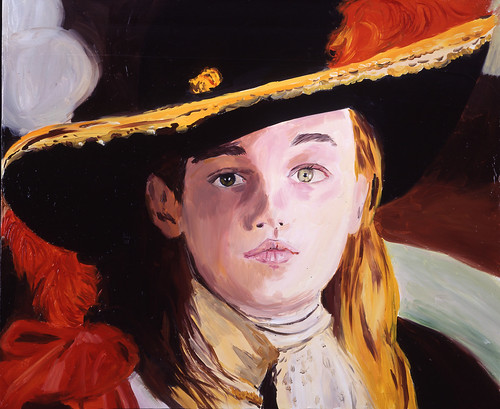
Karen Kilimnik painting of Prince Charming in her show at ICA.
Karen Kilimnik’s art is like an archetypal teenage girl: seductive, contradictory, messy, pretty and angry. The internationally renowned Philadelphia artist is a cultural sponge. She soaks up news and information from today, yesterday and 300 years ago, and uses it to comment on everything from art, ballet and architecture to mass murder, drugs and child abuse.
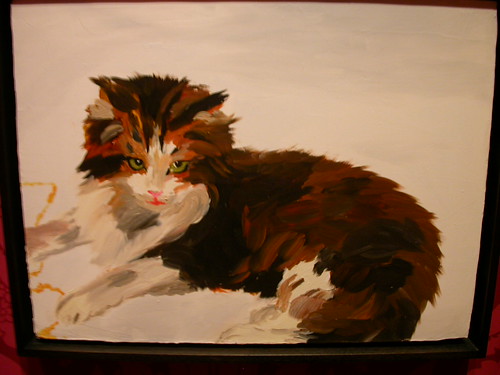
Karen Kilimnik, painting from the Red Room, downstairs at ICA.
Kilimnik’s second show at the Institute of Contemporary Art covers 20 years of drawings, paintings, sculptures, videos and installations. Walking through the two-floor show is a hallucinatory experience, like a dream or a fun house. Downstairs in a specially made red-roomed chamber, 49 brushy and breathless old masterly paintings of pretty chateaus, pretty children and pretty animals take you to safe and fantastical places. There’s a second “safe house” upstairs, and inside it is a video loop screening clips of ballet performances. It’s all pretty, quiet and seductive.
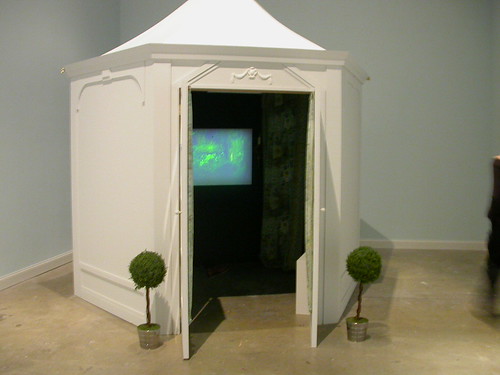
Karen Kilimnik’s Bluebird’s Folly at ICA, a little “safe house” on the second floor.
Outside the little houses, though, Kilimnik’s drawings, photos and scatter-art offer a jolt of tabloid-fueled police-blotter shock and schlock—like the references to the Charles Manson murders and the Lisa Steinberg child-abuse murder. Outside the safe houses, this show is anything but safe.
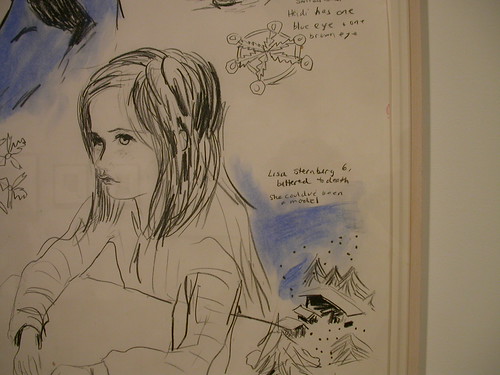
Drawing by Kilimnik. “Lisa Steinberg, 6, battered to death. She could’ve been a model,” says the drawing.
Perversely, this tabloidesque work has a private feel to it: The drawings look like they’ve been torn out of an obsessive’s sketchbook. The installations feel created by someone whose passion for crime scenes drove her to reenact them. The sense of privacy turns the viewer into a voyeur, and I think that’s the point. We’re all worshippers, obsessives and sickos with murder and mayhem on our minds.
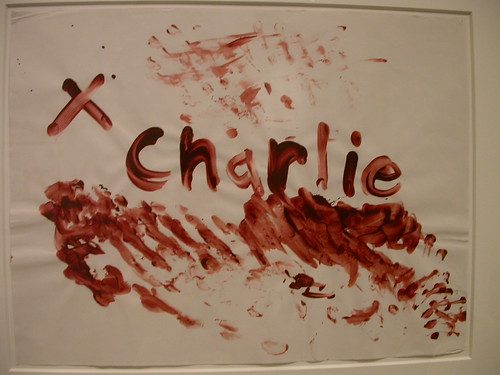
Kilimnik shocks with her ability to move through vast swathes of territory and leave you guessing at her meaning. Blood Drawing (Charlie) I, which contains only the word “Charlie” and some smudgy fingerprints done in what might be blood (it’s ink), is icky but captivating. You want to look at it and revisit the murder—and that voyeuristic impulse laid bare in the cold light of a museum comes as a shock.
It’s been said Kilimnik considers her exhibitions theater. As you move from one station or scene to another, the effect is indeed stagy. The viewer is both the audience and the player who completes the scene.
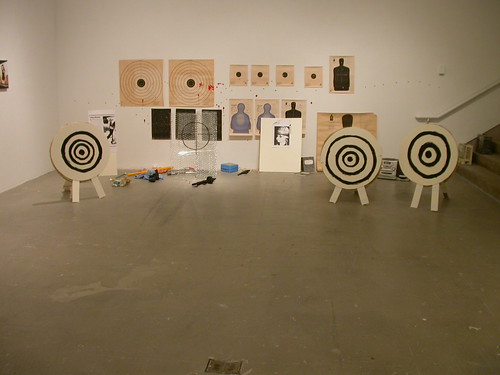
Kilimnik installation based on schoolyard murders. As topical today as in 1991 when it was made.
A point of comparison is California artist Raymond Pettibon, a drawing artist who’s also fascinated with guns, crime, pulp fiction, lies and the shifting sands of identity. His images, like Kilimnik’s, are photographic and interiorized. The cryptic phrases he writes next to his images—while more literary and less teen sketchbook than Kilimnik’s—are nonetheless highly ambiguous, ironic and faux private.
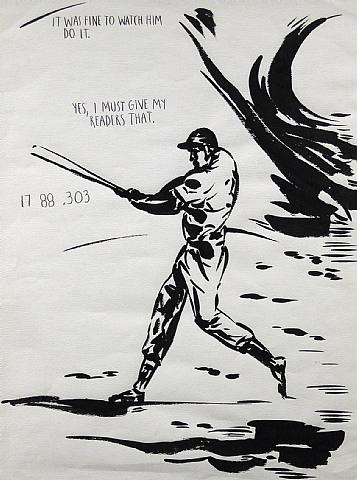
Raymond Pettibon drawing. Pettibon had an exhibit at the PMA in 1998 and the catalog for the show is the great Raymond Pettibon Reader, a compilation of drawings by the artist and short excerpts from writings selected by him and the curators. The writings go from a rambling tract by Charles Manson to excerpts from heavy-hitters Samuel Beckett, Walter Benjamin, William Blake and George Santayana.
If this show is a carnival, Kilimnik is the artist behind the funhouse mirror, and she’s not just reflecting the world but passing judgment on it. The world is one of terrifying slipperiness where the pretty coexists with extreme thuggery. And the real horror is that we’ve all adapted to it.
Karen Kilimnik
Through Aug. 5. $3-$6. Institute of Contemporary Art, 118 S. 36th St. 215.898.7108.