
By libby
November 14, 2011 · 9 Comments
The moodiness of collage nearly overwhelms the show of work by John Stezaker at Rosenwald-Wolf Gallery in his show The Nude and Landscape. But then the sharpness of Stezaker’s intelligence and eye pull it back from the brink, seducing with beauty, complexities, surprises and ideas.
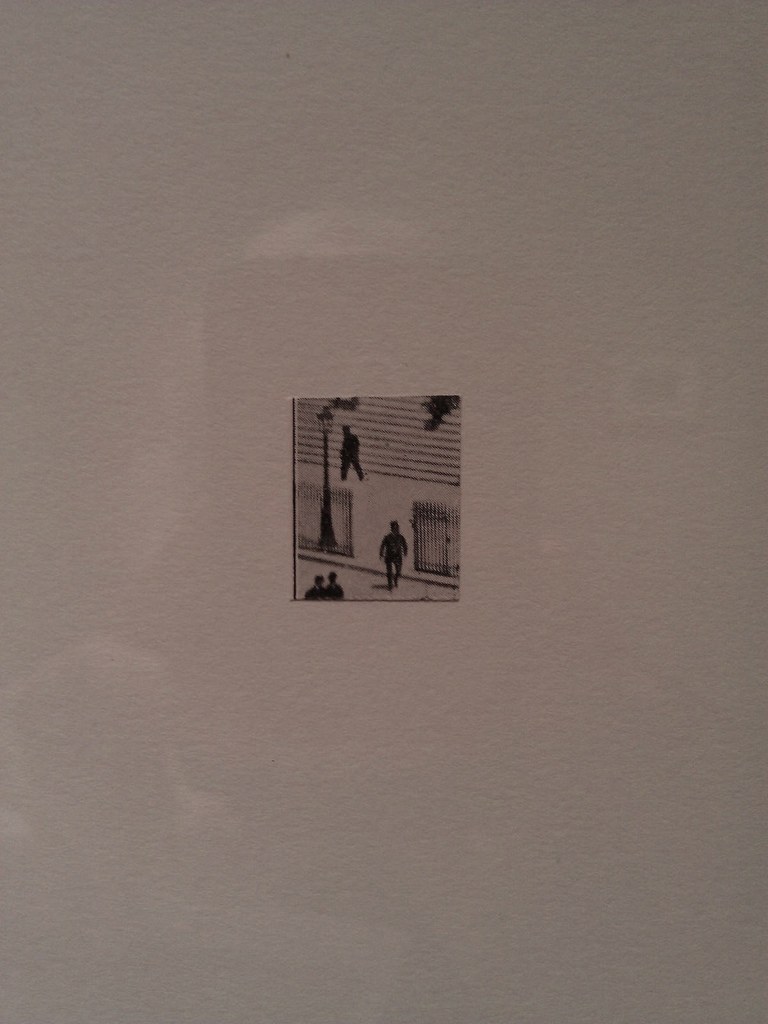
John Stezaker, Pursuit V from the 3rd Person Series, 2011 collage, 5th of 7 parts, 7.9 x 5.4 inches (includes mat); actual image is about an inch!
Stezaker had a recent solo show at London’s Whitechapel Gallery, and he shows at Petzel in New York. (Friedrich Petzel himself was at the sparsely attended opening at Rosenwald-Wolf. Perhaps it was the rain that accounted for the low turnout).
To put this another way, if you’re in a rush, this is not the show for you. But if you have a little time to visit with the work here and get up close and personal, you will be rewarded, not because you have to know so much and be a big art history buff, but rather because this work offers visual and intellectual puzzles based on the ordinary visual culture of our civilization–magazines, photos and newspapers.
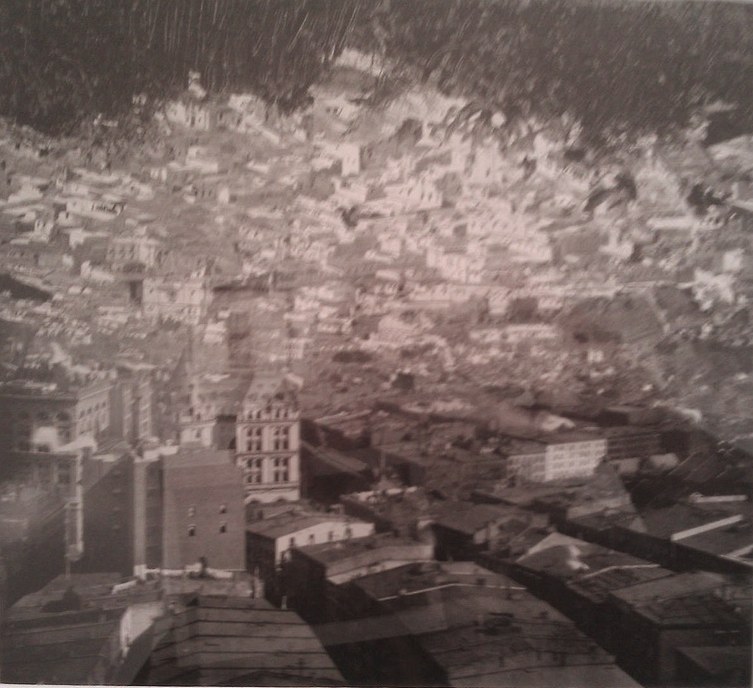
Once I got past the sad undertext of all collage–reused materials, previously rejected and remaindered–I found trippy worlds reimagined. There’s a challenge Stezaker sets for his viewers, and I can’t help but think he’s a bit of a cranky person. But I sure did like these not-quite-friendly collages.
My favorite piece was a series of seven collages (see top image), although calling them collages is a sly trick. The images are simply stamp-size cut-outs from larger images. Each cut out is a single, intact rectangle glued in the center of an approximately 8″ tall mat board. The images highlight tiny figures in action excised from some corner or background of larger images–the things we rarely pay attention to as our editing eyes and minds focus in on the main subject. The line-up of seven suggests a cinematic storyboard, with a mysterious tale to tell of something momentous about to happen.
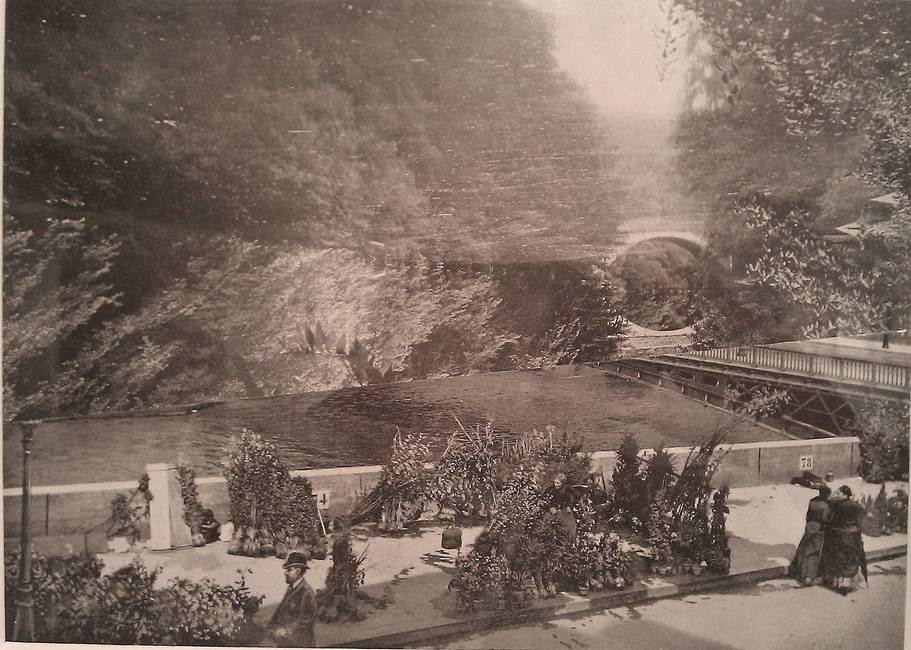
In an equally puckish approach, Stezaker does a double Duchamp reference in using a ready-made, an old travel postcard, which he presents unaltered. By naming it Nymph, he turns a landscape with a waterfall into a bit of erotica that seems to reference Duchamp’s Étant donnés.
In Underworld XV, a single slice joins pieces of two different landscapes. The upper half, however is an inverted view of land, confusing the eye’s expectation of horizon and sky. Puzzling out the what and the why and the where is pretty wonderful!
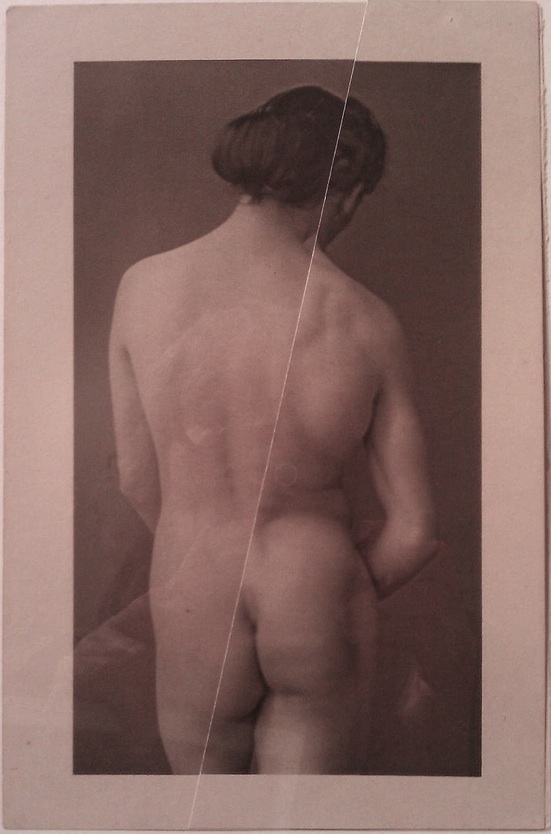
The male-female nude mashups might have been more fun if I hadn’t seen similar work from Philadelphia photographer Paul Cava previously.
Exhibit Oct. 13 to Nov. 19, 2011
Monday – Thursday: 10 a.m. - 5 p.m.
Friday: 10 a.m. - 4 p.m.
Saturday – Sunday: CLOSED
Rosenwald-Wolf Gallery
333 S. Broad St.
215 717 6480
Tags: collage, friedrich petzel gallery, john stezaker, rosenwald-wolf gallery, whitechapel gallery
I’ve know John Stezaker’s work for years. Who hasn’t been seduced as both artist or as viewer by the marriage of a man’s smirk and a woman’s smile in a single, vaguely violent portrait? Three pairs of eyes spliced together, a copy and a Hollywood starlette joined at the teeth, a big nosed actor living in the face of some quiet spinster are all collage strategies born of the 1930s and 40s and methods of cut and paste John Stezaker has more or less mastered.
I see these combos more like cocktails that look weird, taste funny offer up a quaint lewdness typical of the medium. The other works – clearly more complex – take on not the overt neuroses of our day but perception, imagination and the plethora of print consciousness and thus glides easily from pretty much any subject to any other subject. Landscapes become psychologically charged, or they become anthems to the horrors of poor prescription glasses, or madness, pure and simple.
Since I trample the same vintage neighborhood and see the crooked sepia-colored faces, houses and front lawns, I do indeed have a little something invested in this cut and paste business and the notion that there really is something behind the curtain and that the Wizard of Oz is still a magician of some sort.
My question about Stezaker remains, however, “What is his real achievement?” Or in another context, à la Richard Hamilton “Just what is it that makes today’s homes so different, so appealing?”
Oh, my goodness. Battle of the excellent collagists! So I wasn’t sure what you were saying re madness. The viewer’s or Stezaker’s? He certainly is doing something different than you are. He is minimal in his slices. In the postage stamp size cutouts, he is cinematic, appearing to add the element of time. And in the landscapes with the single slices, he creates a juxtaposition and final product that hold my eye and interest for far longer than the 3-second rule. I actually spent several minutes engaged with each of them. And in that sense, too there’s the addition of the element of time, although of a different sort. I did find my eye traveling around the picture and its surreal space, enticed by unexpected pathways. I think that makes these pretty good. And that’s no skin off your nose, no glue off your collages.
Libby, I think you are right in the essential: Go beyond the 3-second rule (or is that the seconal rule?) and find yourself there. I agree there is something and someone to look at at Stezaker’s bazaar, I just wasn’t fully convinced of the authenticity of it, perhaps. Oh to be a rock and not to roll.
As for madness, I was referring to the subject, but Stedzaker could be mad, sure, why not? I am. Most people are, he probably is. His subject lies in that blurry, double and 3-d vision. Hey, I’m glad to see him and his ideas here. I’m sure those of us who thrill to cut paper and odd cuts of stuff like that there, are happy to see a cutter among us.
There is the slippery idea of cutting out a rectangle, pasting it on a white background, and calling it collage. Yet these were my faves–I love a good idea, well executed–because of all the thought behind what he chose and what his source was. To put it another way, the popular culture content of movies immediately brings something worth bringing to a technique that has that whiff of the past (although the movies that come to mind looking at these are assuredly not contemporary, but rather noir spy thrillers of the past, like the Third Man or Casablanca). So maybe it was really the action quality, the sense of a time-driven medium rather than popular culture or contemporaneity that made me fall in love. (hope that made sense)
Yes, it does, Libby. He’s film noir in his b/w material, and 30s and 40s in his cut ups. But…to me his work is like filling in a gap he found in between railroad ties. Probably just me, though.
Good conversation about all this, I just wish I could edit my comments above – I see grammatical errors in them and it drives me nuts.
Well, I do agree there’s a dryness to Stezaker, a hermetic quality. (But I still fell right down the rabbit hole.)
I have not seen his work in person, however from what I am gathering, is the shadow of the paper layers becoming part of the art? The idea in the landscape piece reminds me a bit of Escher….and his improbable situations.
Really? The shadow of the paper? Could you please explain?
BTW, Interesting web site from Julie Takacs, collageclearinghouse.blogspot.com