By roberta
August 15, 2006 · 16 Comments
This week’s Weekly has my review of Pay to Play, the guest-curated show at Black Floor Gallery. Below is the copy and here’s the link to the art page.
Here Comes the Bribe
Black Floor’s “Pay to Play” show is topical but shallow.
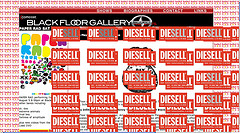
Albo Jeavons’ “corporate” takeover of the Black Floor website. Beware of going to the website because it may freeze your computer. I got in and out on my mac but others have had trouble.
The basic requirement to get into the “Pay to Play” show at Black Floor was the artists had to offer creative bribes to the curator. With that call to arms, it’s no wonder the show is full of works about money, marginalized populations and sleaze. It’s a shame more artists didn’t have fun with it.
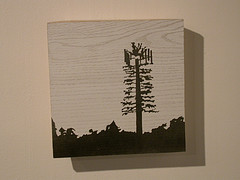
Adam Eckstrom’s silhouetted cell phone tower tree, painted on wood panel. The work is a lovely portrait of an unlovely thing pretending to be what it’s not.
Mostly—although there are exceptions in works by Albo Jeavons, Charles Hobbs, Lizz Wasserman and Lucas Blalock—the 15-artist show has so many lead-footed political statements that it’s the visual equivalent of “Just Say No”: a little bit pat and low-energy.
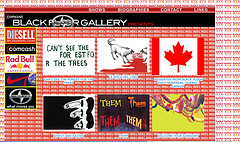
The Scorn icon (Scion) moves around like a shark fin in front of the Gallery’s logo.
For all the artists’ well-meaning efforts about pornography, self-image, terrorism, cell-phone towers, homelessness and urban gentrification, much of the content is thin and even a little generic.
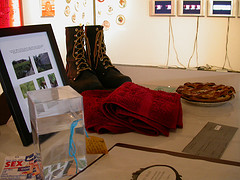
The bribe table, including embroidered towels, boots, gift certificates, photo-documentation of a tree planting, stickers, some water, an apple pie and more.
I don’t doubt the sincerity of any of the works. What I wonder is how personally engaged some of the artists are with the subjects and whether—and this is how it felt in places—these pieces are cause-of-the-day toss-offs instead of works that come from a deeper place.
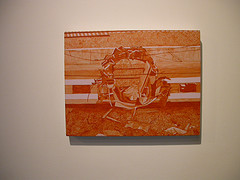
Mauro Zamora’s painting of an explosion hole ripped into what looks like a train (perhaps a reference to those bombings of the Spanish railway?). Another lovely work portraying contemporary horror.
The exceptions are those artists whose works are either more nuanced or more high-spirited, or both.
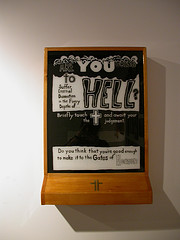
Charles Hobbs’ interactive piece. Touch your fingers to the metal cross on the bottom of the wood panel and the piece flashes either “heaven” or “hell” in the black area above. It didn’t work for me but the show’s guest curator Amy Adams’ had the right touch and the piece told her she’s going to Hell.
Albo Jeavons’ art would stand out in any crowd. The local artist is well known for his anticorporate, antiracist installations that have appeared at Nexus, Space 1026 and Klein Gallery, as well as on the city streets. Jeavons is represented here by one of his trademark 3-D cartoon figures, but his more telling mark on the show isn’t visible in the gallery. Jeavons staged a mock corporate takeover of Black Floor’s website. Go there and see the annoying parody pop-up ads for corporations like Comcash, DieSell, RadBull and Scoro (for Scion). This spot-on intervention demonstrates in one fell click the money-equals-power equation, and does so with more panache and sense of mischief than anything else in the show. (Although Black Floor did grant permission for the website takeover.)
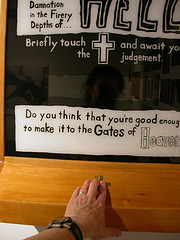
I love interactive art. And this piece is beautifully made and has just the right mix of carnie barker and religion to be very smart about both.
Other nuanced, high-spirited works are Charles Hobbs’ Are You Going to Hell? interactive game, Lizz Wasserman’s drawings of celebrities on commemorative plates salvaged from thrift stores, and Lucas Blalock’s digital C-print American Standard, which shows a man trying to pull himself up by his bootstraps.
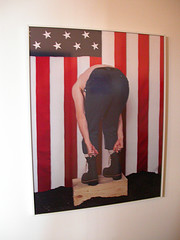
Lucas Blalock’s guy pulling himself up by his bootstraps. Of course he’s mooning you, too.
The bribe table (too bad the loot wasn’t put “under” the table) includes an apple pie, an invalid gift certificate, and the photo-documentation of a tree-planting. I wish the bribes taken had been dirtier—like real money or real payola. But that’d be a different show.
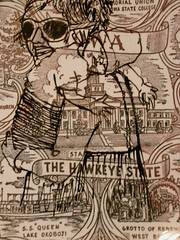
Detail of one of Lizz Wasserman’s commemorative plates bearing her drawings of celebrities. I like how the drawing almost disappears here, and how the whole thing is grey and ghostly, a comment on fleeting fame and fleeting memories.
Political art needs to be made with gusto and created with head and heart. When it is, experiencing it can be transformative. Artists like Pepón Osorio, Sarah McEneaney, Jane Irish, Mark Shetabi, Andrea Fraser, Rirkrit Tiravanija, Komar and Melamid and Cindy Sherman—to name just a few—make works not only politically engaged, but “soul works” that come from the artists’ cores. The mix of personal and political can make this art unforgettable instead of merely topical—the category into which I’d put much of the work in this show.
“Pay to Play”
Through Aug. 27. Black Floor Gallery, 319A N. 11th St., third fl.
Tags: adam eckstrom, albo jeavons, black floor, charles hobbs, lizz wasserman, lucas blalock, mauro zamora, painted bride, pay to play
In my mind, when I see so called Political Art certain questions always pop up. What exactly are the artist’s intentions? Is it to educate me about a certain political subject? Is it to spur me to political involvement? Is it to change my political beliefs? Is it to allow me to hear a previously under represented voice? Is it so the artist can tell me about their personal connection to a current political subject? Is it to spur debate? How much should I judge the work on it’s formal and artistic merits,if at all?
I’d personally prefer to get my political comment from the editorial pages of the NYTimes, Daily Kos or CNN, or the SUN or something. A printed or verbal source without the trappings or pretensions of being “art”. And rarely does Political Art educate me on anything. And come on, isn’t a lot of this stuff preaching to the choir? Liberal viewpoints presented to a Liberal audience. What’s the point? I’m really not interested in an artist’s personal emotional or intellectual reaction to a current political situation. No editorialist worth their salt would get by on just that. But many arists do. Human tragedy and injustice is not simply fodder or subject matter for one’s artistic ambitions or inclinations.
That doesn’t mean I don’t think art with political content can be wonderful or even effective. You know, blah, blah Goya and Guernica and all that. Political Art, presented to the public, often wants it both ways…to be politically relevant and to be ART. It wants it both ways. It asks a lot. And a lot should be asked in return.
Good points. Some artists are by nature political beings and for them the making of art is intertwined with life. Whether or not the art is preaching to the choir, the art gets made because it has to be made. And there should be an audience for that. I know I look for it and am always happy to make it. By political art I don’t mean just things that deal with topical issues, although topical issues may crop up and be valid in them. Thomas Hirschhorn’s Camoflage piece at the PMA is one whose topicality I accept because I believe it comes out of the core aspect of his art making. It’s not a band-aid slapped on.
I agree that political art wants it both ways and that much of it falls short. But I’m always looking for the great stuff–it exists. Did I put Rikrit Tiravanija in that list? If I didn’t that was an oversight.
Oops, Freudian slip in that last comment:
Let’s try this sentence again:
CORRECT
And there should be an audience for that. I know I look for it and am always happy to see it.
NOT
“And there should be an audience for that. I know I look for it and am always happy to make it.”
Sure I gotcha. But here’s an example of what I’m talking about. In the current issue of Art Journal there is an article about the artist Perry Bard, who did a piece that featured a billboard truck with the cutout images of Near Eastern Artifacts pilfered from the Baghdad Museum during the invasion of Iraq in 2003. One month last summer the truck was driven around the streets of Manhattan and as the article says…”entreating passerby,’Have you seen these missing objects? ‘Are you aware of what goes on in your name?’.
As with a lot of political art, it helps to have critical cheerleaders to explain it to the peeps. The article goes on to draw parallels to the pillaging that went on in “Napoleans day” by Europen Empires(the results of which fill up various National Museums) and went on in Bagdad in 2003.
But wait a second. First of all, I know full well about the history of empires and cultural subjugation and all that. Thanks for telling me. That’s History 101. And I know full well what is happening in Iraq.
Secondly, by all accounts the pillaging that went on in Bagdad in 2003 was done by IRAQIS, themselves. Granted, Rumsfeld and his “stuff happens” comments and general attitude allowed it to happen, but there’s a big difference betwen what is happening now and then. Perhaps what is happening now is worse, but what is the real point here? The name of the art piece is, STATUS: STOLEN. But I don’t know what point the artist is trying to make. I know what the critic Gregory Sholette of Art Jouranl WANTS me to think but it just doesn’t wash. It’s intellectually sloppy.
The cutout images of Eastern Artifacts from the billboard truck are featured throughout my current issue of Art Journal, every fifty pages or so. They function nicely as a graphic element that might give a feeling of vague political connectedness to the art academics who subscribe to the journal. Perhaps another kind of cultural pilfering.
I might be mistaken, and I have not yet seen the show, but knowing Mauro Zamora’s work, isn’t his painting the one of the silhouetted cell phone tower tree? And Adam Eckstrom’s the one of the blown up train?
For every good project there are 10 bad ones–like this one you mention which sounds really lame. And not even topical. The pillaging was 2003 and the moving billboard project was 2005 and the Art Journal piece is 2006???? What is that magazine thinking?
When Target and the New Yorker did a similar image “infestation” project in the magazine last year (remember all those red and black target cartoons by many different artists?) it was less hard to stomach because it was simply a corporate takeover for money. It was just business. It happened to have some graphic impact and I believe it funneled some money to some artists so that’s good.
But you have to wonder why Art Journal covered this project in the first place when there are so many other deserving projects that are better.
hi silvio, mauro’s piece is the blown up train and adam’s is the cell tower.
Oh well, Roberta, I stand corrected.
I also want to respond to John Tallman’s first comment. Why such conundrum about political art? “What exactly are the artist’s intentions?” How about responding to events in the world through his/her medium as honestly as possible? If you don’t like the response, then walk on to the next artist. Certainly Goya didn’t prevent any of the atrocities he documented, but he laid down what he saw and felt, and now we can look at what he made and respond how we see fit. Same goes for any other artist, writer, or director. “Farenheit 911” was certainly a flawed movie, but it certainly did provoke a response, whether you liked it or not. And befuddlement is also a response. Why do you need a program of proper responses to any art? How you respond is how you respond, and that includes rejection of the work.
And that only liberal artists make political art “presented” to a liberal audience is just utter nonsense, stereotyping of the worst kind. No artist worth the name ever makes art to “present” to just half the population. You are just using cliché to dismiss. You say that political art often wants it both ways…to be politically relevant and to be art. The artist doesn’t “want” anything: he/she makes the art and puts it out into the world and then comes the response. Just because you have no use for that kind of vision thrown in your face in a gallery, it doesn’t mean other people reject it. A lot should be asked on ANY art, even stuff that’s just for pure entertainment, why should political stuff have it’s own set of rules.
I think it’s fair to say the majority of people who regularly attend museums and galleries and give a rat’s bumm about contemporary art and culture are of a liberal persuasion. I also think the vast majority of artists who make “political” art for those galleries and museums are for the most part, liberal. I never said “all”. I don’t think that’s stereotyping of the “worst kind” anyway. I didn’t write anything about race or religion. Don’t you think that kind of stereotyping is a bit worse?
Quick, name me five contemporary artists who make Pro-Bush or Pro-Right Wing art and get regular contemporary art press exposure. Ok, I’ll take three. Give me three, two…?
And surely,SURELY when an artist produces his or her art, they want or expect some kind of response from the viewer. Aren’t we all in the communication business? If we are not, isn’t sort of “navel gazing”? Shouldn’t you know your audience? Every artists makes work to be seen by OTHERS. C’mon. And every artist has their niche audience, don’t they?
And, it’s just a personal opinion, but “responding to world events through one’s medium” doesn’t hold much interest for me. Maybe I’ve seen that done halfbaked so much in the last 15 or so years it just doesn’t have the zing it used to. It’s too reactive and seems to lead to these kneejerk, shallow responses. By the time the artist goes through the whole process of “repsonding” the world event has passed(or the context shifted) and it frequently starts looking extremely CONTRIVED. I think blogs and so forth are able to “respond to world events” a lot more directly and honestly.
It seems like what is really at the crux of John’s initial post here is what criteria do we use to evaluate political art? E.g. John, and potentially other viewers, have trouble discerning what is the problem the artist has set out for him- or herself? I think that of course part of your judgement of the work should be on its formal and artistic merits, though it bears mentioning that political art often shares a distinct aesthetic. Personally I judge all work on both its form and content, be that content political or not.
I wonder why the questions we ask of political work are so different from those we ask of other work. John states that he is not interested in the artist’s reaction to a current political situation; does this extend to other content? I would suggest that a good deal of contemporary art is about an artist’s reaction to *something* be it a political event, a personal event, an environment…. And John (not to pick on you) might just not care for work that is personal in nature, or narrative in nature, or about something beyond formal concerns, etc. It would be important to establish these distinctions.
I happen to agree that a lot of political art is not particularly successful or compelling, but I also happen to think that a lot of art is not particularly successful or compelling, much as I am involved with it.
One of the most interesting aspects of this show, from my perspective, was the use of the bribe to obtain entry in the show, and the results were not really interesting on this point. I know of some bribes that were unsuccessful that I found considerably more involved and compelling than an apple pie. (Disclosure: yes, I myself made one of those bribes.)
Another question for evaluation: as the show looked at corruption and failure in the outside world, did it apply that lens to itself (the art gallery in general or the jurying of this show in particular) when it chose to coyly accept bribes?
John, if you want to divide the art world in these utterly useless right wing/left wing, red/blue, who’s a liberal/who’s a conservative methods, go right ahead. You look at one aspect of “contemporary art” and see all these liberals coming out of the woodwork: maybe you’re not looking hard enough. For example, walk into most galleries in the Southwest and Texas (Bush land) and see what people are looking at and buying: a lot of heroic Cowboys and folkloric Indians, a continuing vision of America’s manifest destiny. Tell me that isn’t “right wing”. But I’m not gonna play that game. I don’t see artists and the making of art that way, don’t divide the world up like you do.
You seem to push everything into a slot, like some Madison Ave. advertising analyst: all this worry about the artist meeting their niche audience and their statements being up to date and relevant. That’s fine for all the media outlets you mentioned, and blogs and all the rest of the hip and timely crap out there, but it has very little to do with the timeless quality of good art. The bad “political art” you see out there, and indeed the bad art period, will be shaken out by time and history. My point with Goya and with other very good political or “difficult” works art is that no one gives “rat’s bumm” about what the exact original political events were, who exactly did what to who: the power is in the work itself, and the human emotions are still all there.
When I said an artist responds to events, I should have rather said an artist responds to life, that is, some deeply felt emotions about life, not the stuff off of the Associated Press. Artists are not journalists. And when you state “responding to world events through one’s medium doesn’t hold much interest for me” you might as well be saying that you don’t care about art: what else does an artist do but use different mediums (paint, film, words, etc.) to put down responses and reactions to life around him, interpret life through other means? You are dismissing the core definition of an artist. And as far as the artist’s intentions, they are basically useless, particularly many years later. Whatever Melville’s “intentions” may have been, I may think of “Moby Dick” as a long, boring tome on some guy chasing a whale; for other people it may inspire their whole life’s achievement (see the recent Studio 360.) In any case, Melville is long dead and has no say in it. Again, there is a lot of bad political art out there, and a lot of bad art period, but stereotyping is stereotyping, no matter which kind is “better or worse”, so please stop it.
Right, responding to “life” rather than what we would commonly call “world events”. Sounds good to me. And F911 is an excellent example of clear and effective political commentary. Michael Moore had a very clear intention and a very clear audience in mind and a he used his medium in a very effective way. As a viewer, that leaves me with a lot more to go on.
I think the questions we ask “political art” are different because the CONTENT is so loaded and pushed to the front, as viewers, we are supposed to take it a certain way. Aren’t we? The content is supposed to push buttons in a different way than a Clifford Still painting. I know what a Clifford Still wants from me as a viewer. I don’t know what a lot of political art wants from me. That’s why I have all those silly questions.
I have no trouble with art that is personal or beyond formal concerns. I love it. But I guess I question how “personal” a lot of it is. It seems like a lot of this personal reacting to current events business produces a lot of generic, generalized results.
Many artists are working topically now because of the War and the crappy direction the Nation seems to be headed. (And if you’re a rich conservative republican you might think everything is peachy). People want to react to that. It comes out of moral outrage. Fine. But I don’t think morality has anything to do with producing art(or it doesn’t need to). The Triumph of the Spirit is great art. It came out of the Nazis. Where does that leave content? Where does that leave the artist’s intent? Political Art gets a lot of mileage because it might have the weight of morality on it’s side. But what if it doesn’t?
Questions. Questions. I’m just throwing this stuff out there. No need to get yer britches all bunched in a knot.
Whoa, getting a little hot in this discussion group, guys and gals. Political art is like politics, I guess, a subject that flips triggers. If I understand the big points here, I’d say that maybe we’re all on roughtly the same page.
In sum:
–not all art is good.
–much politically- and topically-motivated art falls into the not-so-good category.
–that doesn’t mean that political or topical art shouldn’t be made.
–the big question is, is it good?
–the answer to that question is complicated.
–what I think is good might not fit your definition of good. That’s not a problem because there’s no right or wrong in art, just opinions.
–as with everything in life, opinions can be formed quickly or slowly. The quicker the opinion, in my experience, (unlike what Malcolm Gladwell would have you believe) the more likely you are to be wrong.
–if political art is subject to different criteria of evaluation than non-political art it is because people make summary judgments quickly about it. Those judgments may be right or wrong depending on the work.
Anyway, thanks for the impassioned comments, everyone!
yes, that about sums it up.
Sorry John and Roberta, didn’t mean to raise hackles, just enjoying an intelligent art discussion. I, too, am just throwing this stuff out: my britches are still smoothly pressed, no worries.
I guess what made me initially respond to John’s comment is that, no, I don’t think there should be special rules and questions for so called “political” art. All art is difficult: it goes beyond reportage and depends on symbolism, analogy, metaphor, memory, collective cultural knowledge, and many other things which are very, very difficult to put in play effectively, and most efforts crash and burn.
I approach ANY work of art with great demands and hard questions, and make no distinction for political art; I’m funny that way. I like what Mary Tasillo said above: “Personally I judge all work on both its form and content, be that content political or not.” Nicely put. John stated: “It seems like a lot of this personal reacting to current events business produces a lot of generic, generalized results.” It seems to me that a lot of reacting to anything at all being done by many artists, including the color fields they see in their dreams and how they interpret the stains they saw on the sidewalk the other day, produces a lot of generic, generalized results. My God, have you looked at how many 20th generation, watered down abstractions are still being produced and shown in galleries? Why this picking on purely political subjects? If these artists are using JUST topicality and moral outrage to get a reaction to their art, and are counting on this reaction to get attention, then yes, they are just bad artists resorting to tricks and gimmicks. But, Roberta, I think you may be on to something: the reason many viewers want to demand more of some of this stuff is that, right now, the issues are still fresh, and it immediately brings up the heated political divisions and the old drawbridge goes up and the mind closes. In answering John, I was simply stating my case for not making these simplistic dividing lines (eg: most political art is made by liberals for liberals, so why should I pay any attention) the basis for approaching art, rather letting art to be judged on deeper and more collectively human criteria.
Admittedly, trying to keep the politics out of the viewer’s response itself is probably futile, particularly in the present atmosphere in this country. Anyway, perhaps I should see the show in question before I post any more comments
I guess I”m i little late in posting this, but here goes:
I just wanted to second Roberta’s assertion: I don’t feel that I have a whole lot of choice; when I make art it comes out explicitly political whether I want it to or not. My personal politics are anarchist and my passionate desire for a peaceful, just, and truly democratic world is what animates everything that I do, including my art making.
The challenge for me is to find ways to avoid some of the pitfalls that John presents and to communicate effectively in ways that will, hopefully, shift the viewer’s perceptions of the oppressive social relationships that we are all so thoroughly entangled in. Doing this within the Art World probably is, quite often, preaching to the choir, but you know; people join the choir because they feel a need to be preached to, and we can only hope that the preaching will inspire them to take some action. Stretching that metaphor to the breaking point, I’d also add add that there may be a few satanists who’ve joined the choir because they love to sing in a group setting and the satanist church just doesn’t have a choir; maybe the preaching will get through to them and change their views a little bit.
My other solution to the dilemma is to work outside of the Art World a lot of the time; producing t-shirts, stickers, posters, videos, public projects, and work on the Internet. My DisneyHole project of a few years ago and the Barnes-Foundation-related project I’m working on right now are both primarily Internet and mass-media based.
I avoided the Art World for many years after dropping out of art school because I didn’t see it as an appropriate venue for the work I was doing – these days I see it as one venue among the many that I”m interested in working in. All art is political, whether it wants to admit it or not – mine is just s little more in-your-face about it than most.