
By roberta
August 29, 2007 · 12 Comments
[This week's Weekly has my essay on bulletin boards as art. Below is the copy with a picture. I'll put another picture in later. And if you have a picture of your bulletin board/refrigerator art, why not send it in and we'll run a little photo post about your art statements.]
Pin-up Artists
Cubicles are installations by and for the people.
Somewhere in your personal space—the kitchen, office, bedroom, hallway—there’s a bulletin board holding notes, postcards, photos, a calendar or other miscellanea that help organize and define you. Whether you’re conscious of it or not, you’ve designed and authored personal installation art.
The organic DIY aesthetic of your hodge-podge picture-and-word-art creation is actually mimicked by artists who recognize ground-up personal statements as more authentic and richer reflections of our times than something cast from bronze and costing thousands of dollars.
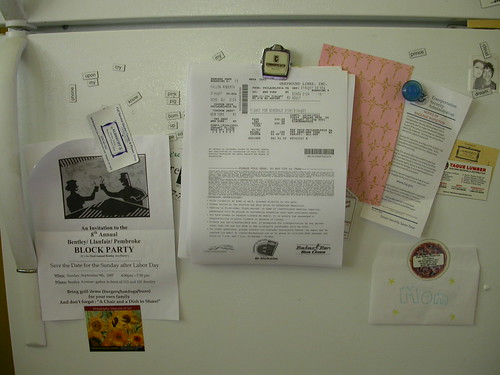
The bulletin board aesthetic is hot right now in the art world. It all started with installation art—the grouping together of disparate or related objects to make an artwork. Installation art came about in the 1980s when artists sought to contrast authenticity with the slick commercialism and superficiality of the art world. Showing real objects like mattresses, car parts, chairs, tables and junk, it was an attempt to say, “Look, art is everywhere—in the office, the street, any apartment or house.” The displays were like exploded 3-D bulletin boards you could walk through.
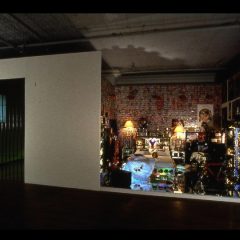
In his 2004 Trials and Turbulence installation at the ICA, Pepón Osorio created a homage to the bulletin board in his picture-perfect office cubicles. One of Osorio’s points is that within the least likely confines humans will aspire to make beauty.
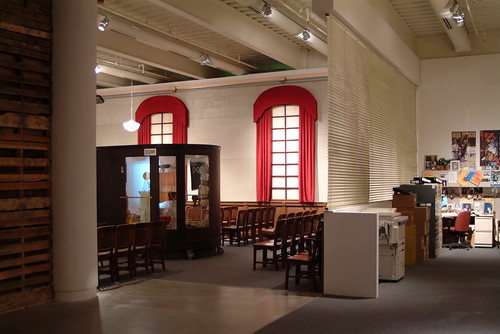
Pepon Osorio’s Trials and Turbulence, ICA. Photo by Aaron Igler.
Nowadays increasing numbers of artists are pinning things on walls, bulletin board-style, and calling it a wrap. Raymond Pettibon’s salon-style hangings of his cartoon poster drawings are one example. Georges Adeagbo, a Benin artist whose Abraham—Friend of God was acquired recently by the Philadelphia Museum of Art, is another.
Abraham, which debuted at PMA last winter, was the artist’s life as a bulletin board. Four walls and a floor were covered with handwritten notes, news clippings from his stays in various cities around the globe, postcards, book pages, straws, matchbooks and napkins from restaurants he’d eaten at, and some hand-carved items that added a decorative touch. The museum purchase of Adeagbo’s piece is confirmation that this type of scattered wall art has made it into the art history canon.
We live in a world dominated by electronically produced imagery packaged to sell cars, widgets and potato chips. Personal space like the office cubicle is the last frontier for expressing something idiosyncratic and noncommercial. We can’t control what’s on TV and most of us aren’t producing content for YouTube, but the bulletin board and refrigerator are there to be conquered. And the only tools you need are pushpins or magnets and a little imagination.
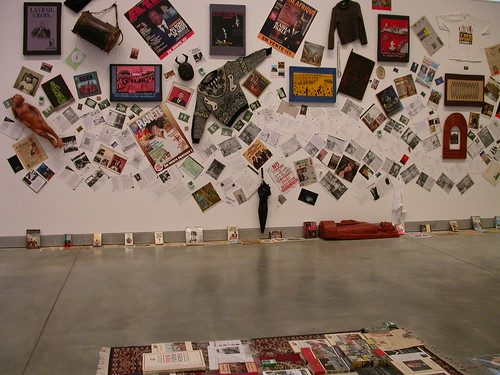
Georges Adeagbo, Abraham, Friend of God, at PMA
Nineteenth-century critic John Ruskin believed everyone could make art if only they applied themselves. “All great art is the work of the whole living creature, body and soul,” he said, “and chiefly of the soul.” Tack your soul on the wall and you may create something truly great.

Tags: bulletin boards, cubicle art, georges adeagbo, pepon osorio, refrigerator art
I have to go with Andrea’s assertion that great art comes out of cultural miscengenation. That’s what give’s Adeagbo’s and Osorio’s bulletin board art its kick. The colliding cultures are a good expression for disparate value systems side by side.
Yeah, it is pretty much just self-application, like Ruskin said. I have a couple of framed pieces from my high school art days, and sometimes I think “Hey, how about I go down to the craft store and get some supplies and do some linoleum printing.” But there’s also something of allegedly greater importance in my schedule.
A couple of weeks ago a colleague asked me what I would do if I wasn’t in ministry and had the talent to do anything else in the world. I said “I’d be an artist”, and was rather astonished at the question. Isn’t that the obvious answer? Who on earth would not want to be an artist if they could? My colleague was surprised at my answer, and I was surprised at his surprise. It had never occurred to me that anyone would not want to do purely creative work, like the visual arts, or music, or writing fiction, if they had the time, talent, and money. It’s like a part of the imago dei; we’re hardwired to yearn to create.
http://www.randallanderson.net
I found this entry interesting and if you look at my web site you’ll see why.
Thanks for it.
Randall Anderson
oye oye oyee….let’s carry ourselves away on a cloud of feel-good feather dusting and call that art too.
to equate Martha Stewart-ish moments of inspired magnet shuffling on one’s kitchen fridge (or office cubicle) while scrambling eggs (or mixing numbers on a spread sheet for the boss) to Pepon Osorio’s labor intensive, extensive installations of materials and concept is not only absurd, but insulting. and i am not even a great fan of Pepon’s work, though i respect the effort.
Arp’s torn up pieces of paper (think post-it notes??) tossed on the invisible tendrils of chance, in the name of art, reveals its poetic underpinnings no better than when compared to the underlying and underachieving implication of this article.
i always thought Arp was sort of thumbing his nose at the establishment when he let drift his portentious paper pieces. this posting essentially equates art to picking one’s nose and applauding it! thank goodness arp wasnot or those scraps of tissue would have stuck, to his fingers that is.
the over-indulgent fuss over personal post-its, push pins and what-nots is reckless commentary that verges on pandering audience appeal the way the Food Channel or This Old House makes everyone think they are a master chef or house-builder.
not to deter anyone from putting those personal finishing touches on their fridge or the stretched office linen that defines their work place. i’m all for investment in one’s personal space. and if you want to do a pear flambe or build a new deck, go ahead. Corporate friends like Home Depot could use your cash investment in this failing economy.
but the jist of this misguided bit of egalitarian goopiness places the larger reaching efforts of some artists who use a cultivated (dare i say, ‘shabby sheek’) esthetic within the same quotidian marching theme touting whatever happens to be the complection of this morning’s refrigerator face.
beyond the pale is all i can say. ‘Low’ art can be a powerful thing. low art critique quite the contrary.
wow, such diverse responses. libby i love bulletin boards as miscegenated material if that’s what you mean. John, go get those lino blocks! randall I love the sculpture with the man covered with paper and abject joe I guess you’re just more of a purist than me. I have heard so many people say that knee jerk “i can’t make art” that it’s disheartening. Of course you can make art. It might not be Picasso or Van Gogh but come on all of us have eyes and hands and are capable of pushing things into arrangements that are visually pleasing.
I believe you misread Pepon Osorio to think that he dismisses peoples’ cubicle art and makes his own somehow “better” and more arty. I think he’d argue the opposite–that he’s reflecting what he’s seen.
We all bridle at the name Martha Stewart but let’s not be snobs here. What’s the harm of someone wanting to decorate and make some beauty? She’s just giving people the tools and information on how to do it. So what. That’s what art school does too.
Georges Adeagbo’s work at the PMA truly shows what’s been happening for a long time now, that the visual aesthetic abroad is far different that what passed for art in the 20th century and before.
We acknowledge ugliness and brut forms of art now and not just pretty pictures of people and the ocean. I’m not curmudgeonly about that. I accept that we’ve grown up aesthetically and can handle hodge podge in our art vocabulary–and some of us embrace it even.
It’s all about whether it’s good or not. Very few of us can be great artists. (Very few of us can be great critics–let’s be honest). But all of us can be ok! And what my point was in this article was to say look around you and think of your space. you made it that way because of your own personal visual vocabulary and visual instincts. Maybe, abject joe, you don’t want to go there, but I think people need to be reminded that art has expanded and can now be many things it never was before….like bulletin boards (see Adeagbo).
It’s not a curmudgeonly position but then I’m not (usually) a curmudgeon.
it’s abject Doe, i’m a female deer, if it matters. though i find it interesting that you concluded i was a Joe
i didn’t say Pepon Osorio would say his work is ‘better’. that was your word. i said pepon osario, to my approximation at least, cultivated an idea and an esthetic and transcribed it for all to see…. in a loaded context, don’t forget (an INSTITUTE of CONTEMPORARY ART), quite different from whatever/wherever ‘everyday’ inspirations encouraged him. and whatever commentary was rendered was a result of that tension.
Osorio inflated his objects and his intent though many see him a a great deflater. and your comments in first post mistakenly follow that misnomer (IMO). the materials are the only common thread between what he did and what you suggest others do…unless some future office grunt suddenly decides to quit work and start devoting herself to making objects or installations out of all the paperclips she’s been hoarding. or, better yet, posting live weblinks to some daily desk installation series she creates surreptitiously while while on the clock–which i have no objection to and would consider art if it continued along some conceptual thread over time..
when i was a young girl, a while back (which might hint to why i am taking such a terse stance?) my father, a plumber by trade, taught me a
lesson about quality and standards. Not so much in terms of taste but a certain accountability to what one practises. anyone can learn to
sweat a joint but that doesn’t connect all the toilets and sinks to the basement water and sewer lines.
the practice of art i have always tried to approach openly but with careful consideration if only out of respect for those past and present who apply/d themselves consistently, over time, to revealing
whatever is unique to their experience…whether in stitching, modeling clay, putting things together with duct tape and foam spray or whatever.
i do believe that it is only across time that applying the practise of art reaches and reveals it full potential. whether one is a ‘great’ artist, as you say, or a mediocre one matters not to me.
it seems to me that the tone of your commentary lowers our expectations not of art but how an individual should apply themselves in order to reach a level of intent and exectution that justifies art as a practise, rather than a nice little DIY moment we can all share in and enjoy from time to time.
it’s not about purity but practise. and i think you portray the practise of art as something all too easy and immediate.
but therein lies the real conundrum, yes? i mean, what good artist doesn’t strive for a final result that has the air of ease and immediacy?
so there ya go…
sorry to misread your moniker, Doe. I truly need new glasses.
Your point about craft and quality and time is a good one. I think there are many artists who could be great who fail because they don’t apply themselves enough over time and let the rough draft go instead of sweating the project to make it the best.
That said, there are those whose art is anti art and whose materials are throw-aways. I’m thinking Richard Tuttle, Karen Kilimnik’s scatter pieces, Adeagbo. For them it’s about the idea, not so much the materials or the craft.
They’ve done a lot of thinking about their art–and truly thinking is part of the process — and yet when it comes to making the work they let it look as if the cat dragged it in. That doesn’t make it bad…or good. It just calls into question the whole idea of craft and quality and says it can be irrelevant.
And I guess I think that’s right. The look of a piece of art should go hand in hand with the intent of the art and the content of it. Matthew Barney uses both fine and crude objects in his work–it depends on what he wants. he’s got industrial-looking cast objects that are sleek and eerie. And then there’s that vaseline goo that is frankly revolting. It just depends on what he’s trying to get at.
Because we live at a time when the definition of art is so elastic we’ve grown to accept the pristine with the goo. Art has a broader definition and more aesthetic “schools” than ever before and that’s because art has let in pop culture and real life (including objects) like never before.
I always wonder if that’s a good or a bad thing. No matter because there’s no turning back.
There’s no Olympic medals for art, and no one who’s best, and no oracle who tells all about the future of art. But if i have to imagine the future of art I imagine art looking a whole lot more serendipitous, hodge-podgy and chaotic before it calms down a little and goes somewhere else.
Art hasn’t been avant garde in years. It’s following edge and the culture leads now. Maybe there’s a way for art to seize back the discussion and elevate it a little but it’s an uphill struggle and I’m still waiting.
Hi, R and L–
It’s not just bulletin boards. The creepy spam in your inbox offers many artful possibilties. See my blog post:
http://joannemattera.blogspot.com/2007/07/sonnets-from-yberspace.html
A sample is below:
“No Side Effects”
Life changing Herbal pills, just a few cents
The thing that convinced me was
No side effects
Our Doctor-Approved Pill Will Expand, Lengthen And Enlarge
I liked it and you will too
Cheap medication
You save $369
Why pay more?
Why wait when you can …
Control your weight
Eliminate belly bulge without exercise
Meet and charm women
No side effects!
P.S. Donna sends her regards
but the jist of this misguided bit of egalitarian goopiness places the larger reaching efforts of some artists who use a cultivated (dare i say, ‘shabby sheek’) esthetic within the same quotidian marching theme touting whatever happens to be the complection of this morning’s refrigerator face.
beyond the pale is all i can say. ‘Low’ art can be a powerful thing. low art critique quite the contrary.
I think that if are to define art and distinguish it from inauthentic art (if such a thing is possible) we have to start not with the question “What is true art?” but “What is a true artist?”
A true artist is able to duplicate in some form (visually, audibly, etc.) the vision within his/her mind. So a modicum of techinical skill is essential. For example, Bouguereau, if he wished, could have created a Pollock. But Pollock could not in his wildest dreams have created a Bouguereau. If an artist creates abstract forms because that is the image within his mind, then he is an artist. But if an artist creates abstract forms only because those are the only forms that he can reproduce at a technical level –that is, if he cannot duplicate the image within his mind — then he is not an artist.
Having then established what an artist is and distinguishing true artists from false, we can then say that art is what an artist produces.
Joanne, I love the idea of spam in your inbox as hodge podge art. And I like the poems you made from the subject lines–very funny!
John, wasn’t it Gombrich who said there is no Art only artists? I’ve always thought that was pretty much it. History will have trouble with art in the 21st century since there are really no movements and everything could be called conceptual. Also, our definition of an artist no longer stops at the stereotype of the trained academician toiling in the studio garret. We now have artists like Jeff Koons who imagine a project and then job out the fabrication. And we have architect/artists like Frank Gehry and Santiago Calatrava seizing sculptural ground and making buildings that are themselves functional art.
It’s a brave new landscape out here in artland.
Hey, JoAnn, loved the poem. It’s pretty funny and almost makes me not regret the pile of spam that comes through my mailbox.
Yo, John, how can you be so sure of this: For example, Bouguereau, if he wished, could have created a Pollock. But Pollock could not in his wildest dreams have created a Bouguereau.?
It’s a surmise in both cases and proves only what you admire. In other words, it says more about you –and the march of time–than it says about Bouguereau or Pollock.
Hi, I’m a student from Tanzania.
I have to develop a homework: “Visits duration and for websites.”
I have written to website owners and asked them about the visits duration of their website.
There are websites which are a guilty pleasure for many. They have an addictive appeal, and lend themselves to at least 30 minutes of browsing per day.
But there are sites which only have a visits duration of 30 seconds. Does anybody know where I can get the visits duration of as many websites as possible?
With the results I want to draw conclusions from visits duration about user´s engagement.
Thanks for your help!
Kira