
The half-life of transgression in the art world has grown awfully short. The first U. S. retrospective of Martin Kippenberger, the German artist whose finger was usually aimed at the eyes of his viewers closed this weekend at the Museum of Modern Art, New York.
The exhibition, organized by Ann Goldstein for MoCA, LA covers work from the mid 70s to the artist’s death in 1997 at the age of 41. That’s certainly faster canonization than the Church allows.
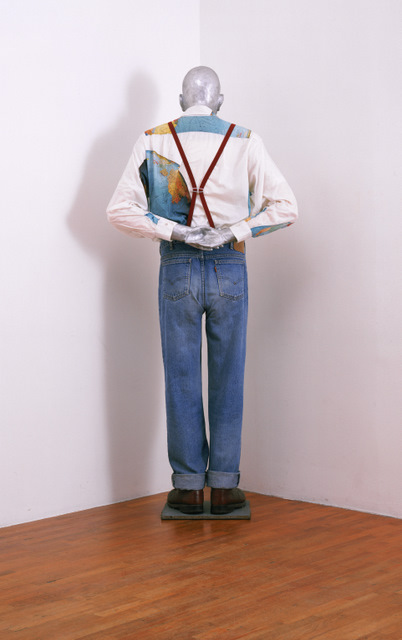
Kippenberger worked in diverse formats: large canvases, small drawings on hotel stationery, snapshot photography, lithographs, artist’s books, sculpture and large installations created primarily of found or adapted objects. But a handful of subjects run through the lot: the failure of the modernist dream (as embodied in modernist architecture and design), an interest in the childish, the problem of confronting Germany’s twentieth-century history, a flirtation with glamour (often associated with foreign travel), male camaraderie and insecurity, the objectification and abuse of women (portrayed with neither irony nor criticism), and indulgence in alcohol and drugs (hard to tell whether this was advocacy or warning). Frat house stuff.
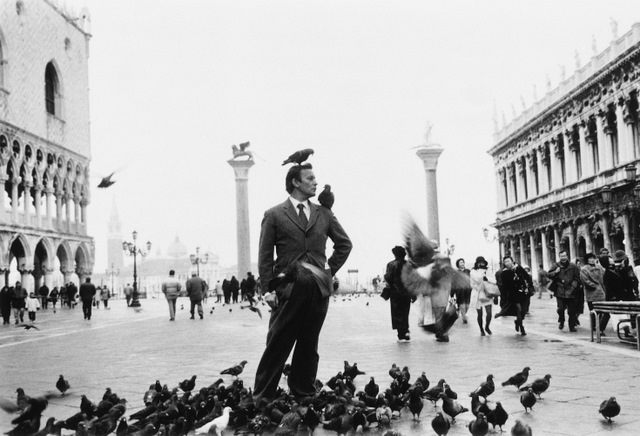
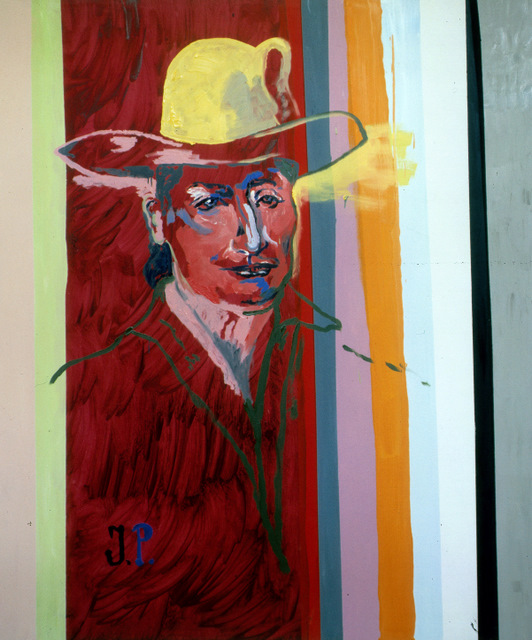
But the most overriding of Kippenberger’s themes, to the point of obsession, was artistic fame. He constantly referred to heroic figures of 20th century art: Picasso Matisse, Beuys, and Richter, and repeatedly cast himself, both abjectly and mock-heroically, in their places. He tried on their clothes so often that it’s hard not to see his mockery of the art world as driven by envy.
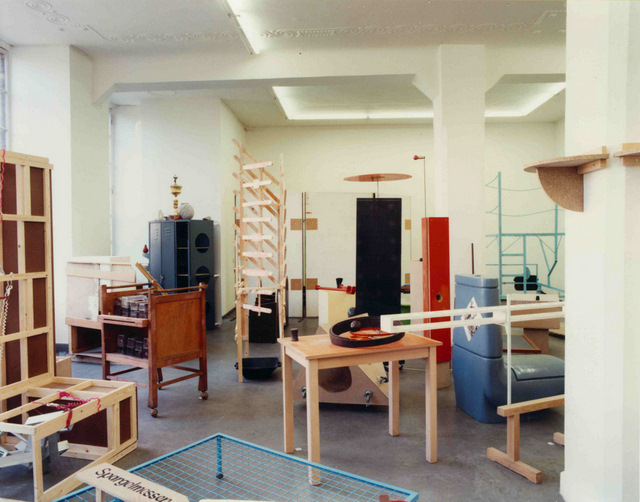
A large group of furniture-like assemblage sculptures, the Peter series (1987), was arranged haphazardly as an installation in the center of a gallery Some contained un-manipulated pieces of furniture (an artist’s easel, various shelves, a set of gym lockers, a bed frame), other furniture-like pieces were constructed by Kippenberger. A picket fence was faced in mirror so the viewer saw a fractured reflection of him/herself. A monochrome gray painting by Gerhard Richter was used as the top of a small table (impossible to recognize the painting, but for the wall text). The repetition of vertical pieces suggested stand-ins for people, and significant allusions were implied (but never clarified) by both the choice of found objects and the individual titles.
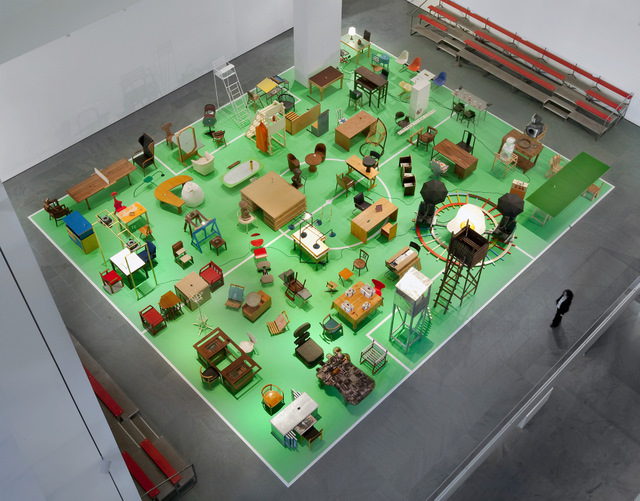
Another installation, this an actual grouping of furniture, filled MoMA’s atrium, so it could be viewed from above as well as at ground level. The Happy End of Franz Kafka’s “Amerika” (which was set in a recruitment agency in Kafka’s unfinished novel) consisted of a combination of classic modern chairs and desks interspersed with odder pieces made by the artist (or Droog designs that I didn’t recognize). They were spread out on a grass-green floor with markings for soccer and a set of bleachers sat off to the side. While the work carried sufficient visual interest for it’s vast size, from above it looked a bit like a miniature golf course while at floor level it resembled an office furniture store conceived, perhaps, by a Martian.
Kippenberger is spoken of as a significant influence on other artists (MoMA presents first major retrospective of influential German artist begins the press release headline), and may well be behind much of the artwork celebrating adolescent, and mostly male sensibility, from Charles Ray and Mike Kelly to Sarah Lucas, as well as the casual-looking combine sculptures that the New Museum exhibited in Unmonumental. I generally found much of the work to be more ambitious in scale than content (which may be why I thought the drawings the most interesting part of the show) and don’t find Kippenberger’s vision compelling. I’d write this off as a generational and gendered response except that the organizing curator, Ann Goldstein, and Ann Tempkin, the curator responsible at MoMA are more or less contemporaries of mine, and I very much respect them both. Perhaps it’s just my blindspot.