
[Ed. note: This post is in response to my Weekly article on “heat” in the local gallery scene, posted here. In my piece I called the paintings by Mark Gilbert at Klein Art Gallery “applied.” Here’s the full sentence in which the word appeared:
The works are large and graphic, and while essentially “applied” art (their goal is therapeutic for the patients and illustrative for the viewer), they make me think about why painting is better at communicating transgressive material than photography.]
Post by Dan Schimmel
Dear Roberta, I have been struggling to write a short piece for Artblog about Saving Faces because I think it is a unique exhibit that challenges contemporary ideas about art and viewership and at the same time does much to comment on our society and ourselves (and the ever encroaching realities of the world surrounding us). Your September 27 PW article and the longer version posted on Aartblog seems to have supplied me the launching pad I needed.
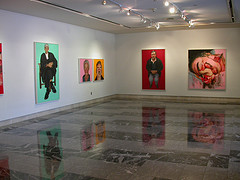
Installation shot of Saving Faces at Klein Art Gallery.
Your article(s) referenced four Philadelphia exhibits under the banner, “Heat, and Why It Matters.” I thought this was an honest and probing approach to considering art exhibits against the backdrop of real life experience. But I do take issue with your characterization of the paintings on exhibit at the Klein Gallery.
In your Flickr photos of the exhibit you questioned the paintings of Saving Faces by asking, “but is it art?” I wondered if indeed you were asking the question from a position of doubt or rhetoric. Not that an institution qualifies art, but I can’t resist mentioning that Saving Faces came to Philadelphia via London’s National Portrait Gallery which is currently promoting a large David Hockney exhibit and has in its collection the likes of great painters like Velazquez, Chardin and a whole bunch more of those old and crusty masters of realism.
Saving Faces is an exhibit that covers a lot of ground and has many applications so when you described the paintings in the exhibit as “applied” art (your quotations) I considered the fact that you might be referring to the broad scope of the exhibit with respect to contemporary experience. But I don’t want to be naïve and as both a painter and gallery director, I recognize that “applied” art is art that is marginalized by contemporary standards. As is the word “illustrative,” which you also used to describe the Saving Faces paintings. Again, if rhetorical effect was your intention, I must thank you for this opportunity to take the bait.
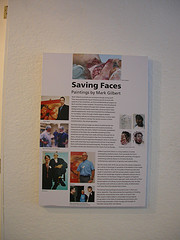
Poster describing the Saving Faces project. Click to see it bigger.
I have found that this exhibit does more to reconnect what today’s art world tends to segregate or reduce, and in fact, I find the paintings in this exhibit effect a ‘reconstructive’ experience, not unlike the surgical procedures being documented. Saving Faces delivers an open opportunity to ponder meaning with our mind fully linked to the humanity of our senses. What better application for paint than to address the reality and vulnerability of the human condition. Paint does this quite well, as you astutely pointed out in your PW article. The individuals that posed for the Saving Faces paintings all did so willingly, and look straight at the viewer with unmistakable nobility and courage; which hardly makes for what you described as a “voyeuristic” experience. I view these as face-to-face recognition that requires the courage and empathy of the viewer to recognize that they are looking at what is most human and therefore shared, vulnerability–and the ability to share it, as these sitters did.
The paintings of Saving Faces were commissioned by Dr. Ian Hutchinson for the purpose of documenting surgical procedures and their potential for patient therapy. But this should not distract the viewer from the broader narrative taking place in this art exhibit. In fact, it is fascinating to consider that these paintings would not have been painted at all if not for the surgeon who commissioned them. One aspect of this exhibit worth considering is its link to the whole of art history of “commissioned” paintings. Again I call attention to Velazquez and those great portraits of the Spanish nobility (inbred with their own deformities). I laugh to myself when I think that Philip IV and his blood line would be the very people today to be the first in line to put themselves under the cutting edge of the most advanced practices of plastic surgery.
Another “application” of the Saving Faces exhibit is that it stirs our emotions and intellect by conjuring up a visceral proximity to the unsettling reality of deformity and disfigurement while opening our experience up to the realm of metaphor; a luxury we as viewers favor over the facts of most of the rest of the world where such conditions are all too real and threatening.
As you must have read, many of the subjects in the Saving Faces were from some of the more impoverished parts of the world. Stepping outside the realm of politics facts suggest that such adverse conditions faced by many regions and peoples of the world, whether mass threat of birth defect or disfigurement caused by work related conditions or war, are directly linked to our own nation’s enduring policies aimed at keeping our populous safe and secure in relative luxury.
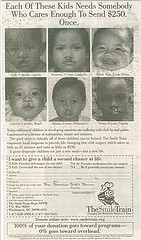
Newspaper illustration of contemporary facial deformity.
The Klein Gallery occupies a very novel and ideal location in a public building, the lobby, a true nexus for art and community! The larger narrative of Saving Faces is illustrated well in remarks left by visitors in the gallery comment book. Below are some vital signs.
Unlike photographs or images viewed through a screen, the skin of each Saving Faces painting has the texture and translucency of flesh. I still recall unwrapping each painting (packing tape and bubble wrap) and the fascinating sensation of peeling bandages from a person’s face, very much like a post-operative nurse or a surgeon.
Saving Faces is not an easy exhibit to look at. There is a certain shock value to some of the images, but when the shock wears off there is plenty of substance that opens the viewer to a depth of experience and understanding that I can only characterize as being full and deeply human. Not one that solicits compassion by calculated association to human misfortune, like a half page ad I saw in another public arena, the New York Times (shown above).
The paintings in Saving Faces are deeply personal and empowering in nature. Not because of the stories of the individuals portrayed, but the access these paintings give us to our own story and how we exist in context to a larger world and the disfigured realities we do our best to avoid in our uniquely American way.
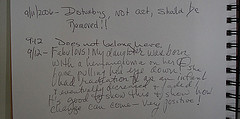
Page from Klein Art Gallery comments book showing comments pro and con the exhibit.
I read the gallery comment book every day and talk to the guard, Kim (who has provided great witness to people’s reactions over the past weeks) and have come to interpret the responses (especially the objections) in ways that continue to expand my understanding of the exhibit’s relevance.
The other day Kim told me a young child broke down in tears when she saw the paintings. Her mother’s reaction was to immediately register a complaint at the reception desk and then rush past the gallery space and the paintings without any attempt to explain the images and alleviate the child’s fears. “That mother don’t understand mothering,” Kim exclaimed. “These paintings are real life. They deserve to be seen and explained to children”
If this anecdote doesn’t sum up what I have been trying to say, nothing will. What is art’s ‘application’ but to put us in close range of reality so as to be disturbed, even frightened, or elevated; and have within it the potential to let us observe and understand and address ourselves outside our routine experience and sit in the open-ended realm of meanings so we can come to our own conclusions based on a full experience that engages on all our senses. How many art exhibits do this anymore?
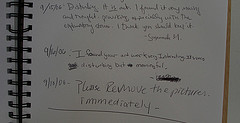
Another page from the comment book.
There is so much more I could write about concerning this exhibit, Saving Faces. The title alone is intriguing to contemplate in context to this culture of appearances that has expanded beyond the personal realm of vanity to compromise the very substance of our culture’s social discourse and perspective. And how this relates to the art world, an applied practice that serves us best when it takes measured steps in course to exploring the human condition rather than taking a distancing effect via intellect to apply itself to social critique and theory. Without the ‘human creature’ (as Walker Percy regards it), today’s art never outlasts its trend or becomes a parody of the condition it claims to fight against, ‘corporate’.
I can’t help but wonder if you consider DaVinci’s masterful studies of anatomy that do more than just illustrate muscle and tissue, “applied” art? I will agree with you on one point. That Facing Faces packs plenty of ‘heat’.
—Dan Schimmel is a painter, frequent artblog contributor and Director of the Klein Art Gallery.