
By libby
February 11, 2010 · 14 Comments
Some great Pop artists who have fallen off the art historical map are now on view in the exhibit Seductive Subversion: Women Pop Artists 1958-1968, at the University of the Arts.
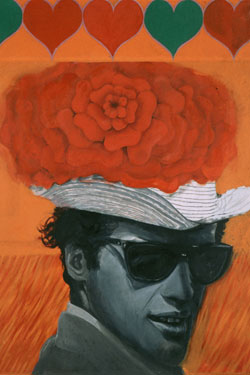
Pauline Boty, With Love to Jean Paul Belmondo, 1962, oil on canvas, Collection Nadia Fakhoury, Paris
In resurrecting them, Curator Sid Sachs points a finger at the political realities of gender and power and the myth of good taste, and how they affect what we see, what we value, and what we choose to write into the record. Sachs’ portrait of the missing half of the story–the female half–expands the narrowed down narrative of Pop Art, which was simplified to the benefit of men, cutting out women and their conceptual–and sometimes aesthetic–differences.
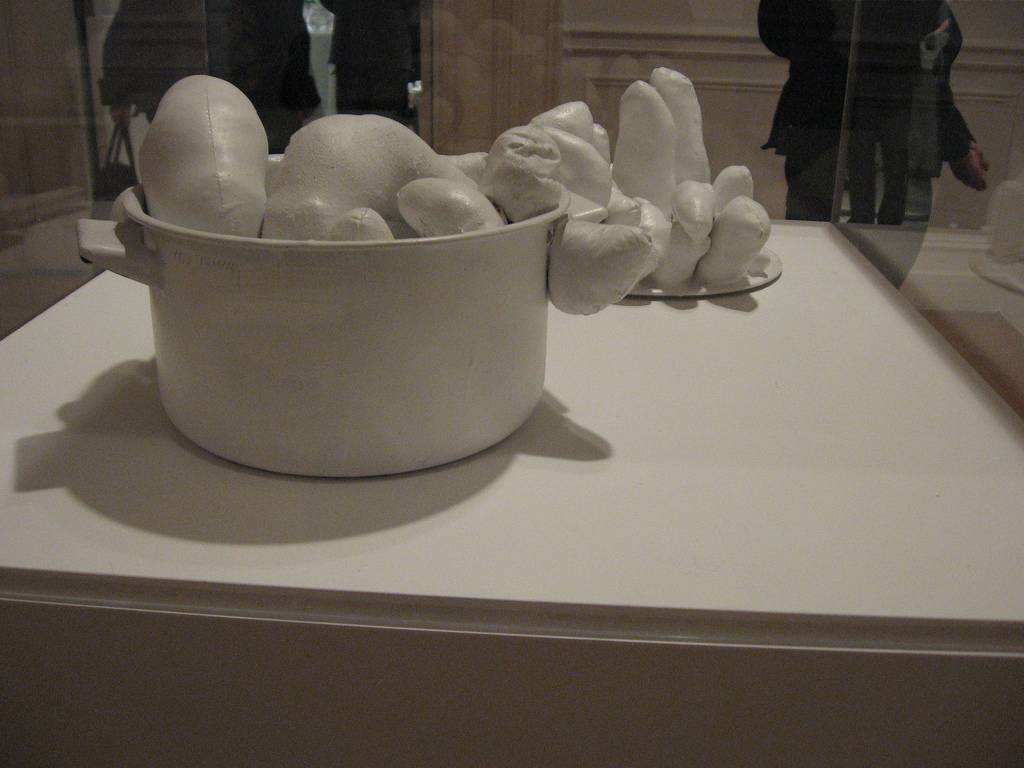
Yayoi Kusama, Untitled, 1963, sewn stuffed fabric, cooking pot, lid, ladle and paint, Private Collection, New York, Courtesy Peter Freeman, Inc., New York
A number of the 19 women in the exhibit disappeared because their devotion to career was subverted by the expectation that women belonged in the kitchen, not the gallery. Sometimes the women themselves let the careers slide. But mostly the social structure overwhelmed their ability to stay on course. That issue was exacerbated by the shabby treatment and lack of support they got from men who paraded as their friends and lovers. Galleries dissed them. Critics ignored them. Art schools belittled them after admitting only those women who were twice as good as men. The women were trivialized and marginalized, expected to be beauties rather than beautiful thinkers and talents. It’s the old story. And the end result was promising careers that foundered and petered out.

Rosalyn Drexler at the opening, in front of her painting Home Movies, 1963, oil and synthetic polymer with photomechanical, reproductions on canvas, Courtesy Hirshhorn Museum and Sculpture Garden, Washington, DC
Some of the artists in this exhibit have achieved some level of recognition for their work–Vija Celmins, Yayoi Kusama, Niki de Saint Phalle, Faith Ringgold, Chryssa, Marisol and Martha Rosler. But none (except maybe Kusama) has the level of widespread recognition that Roy Lichtenstein or Ed Ruscha acquired. (Celmins’ recognition is not primarily for her Pop work). Yet each of these artists is arguably as important and profound, making art objects in dialectic with the culture of the time.
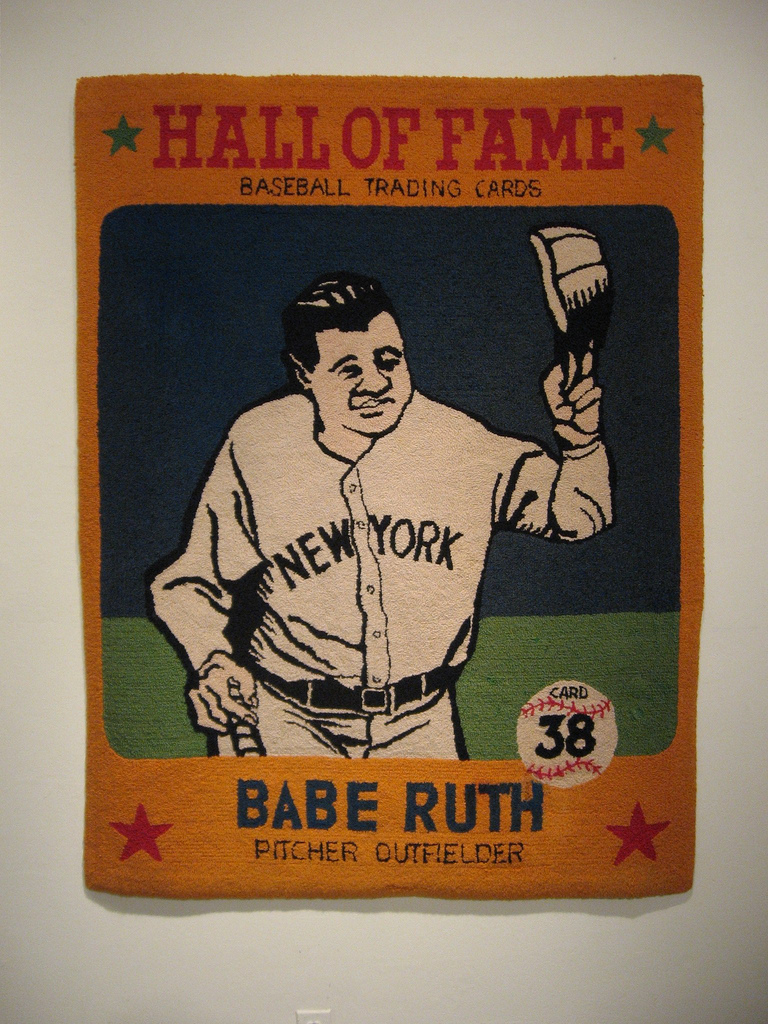
Dorothy Grebenak, Hall of Fame (Babe Ruth Baseball Cards), 1964, wool hooked rug, Courtesy Allan and Clare Stone
Pauline Boty’s portrait of French actor Jean-Paul Belmondo is enough of a reason to go to this exhibit. The painting is red-hot sexy and riveting, with a Freudian bed of roses, atop his head. Also tops is Dorothy Grebenak’s Hall of Fame hooked rug, filled with love not just for its subject, Babe Ruth, but also for all those grubby-handed young collectors of baseball cards. These are passionate works that bring their subjects into the artists’ own world–Belmondo in proximity to Boty’s booty and Ruth and the cultural phenomenon of baseball cards woven into family life.
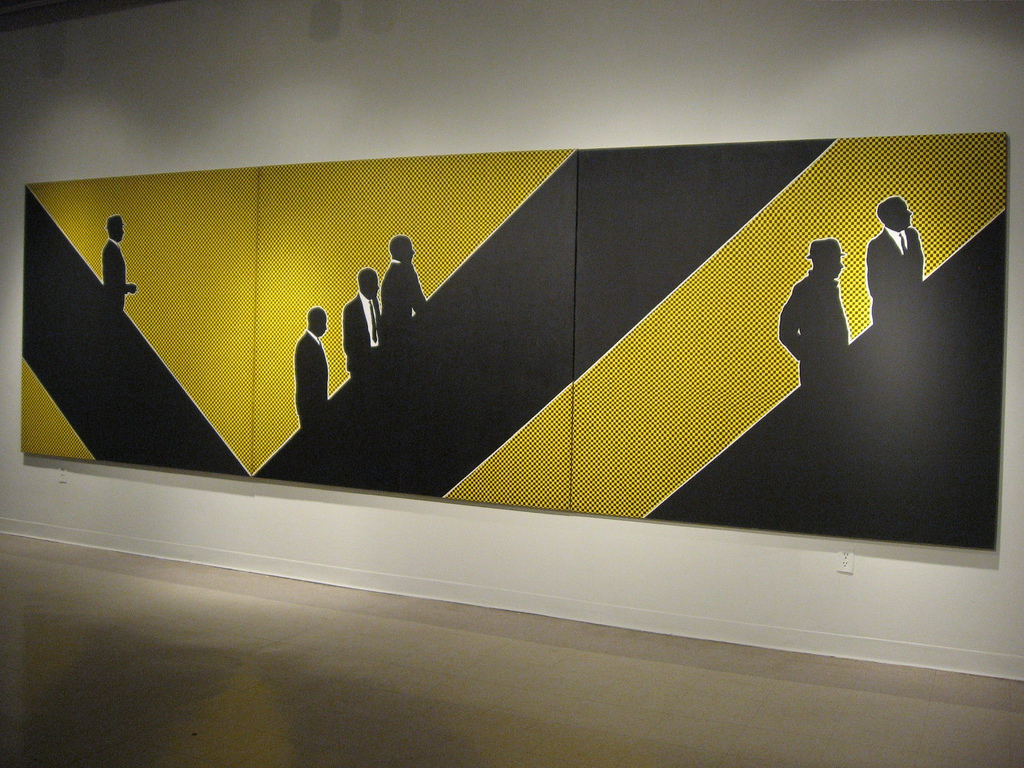
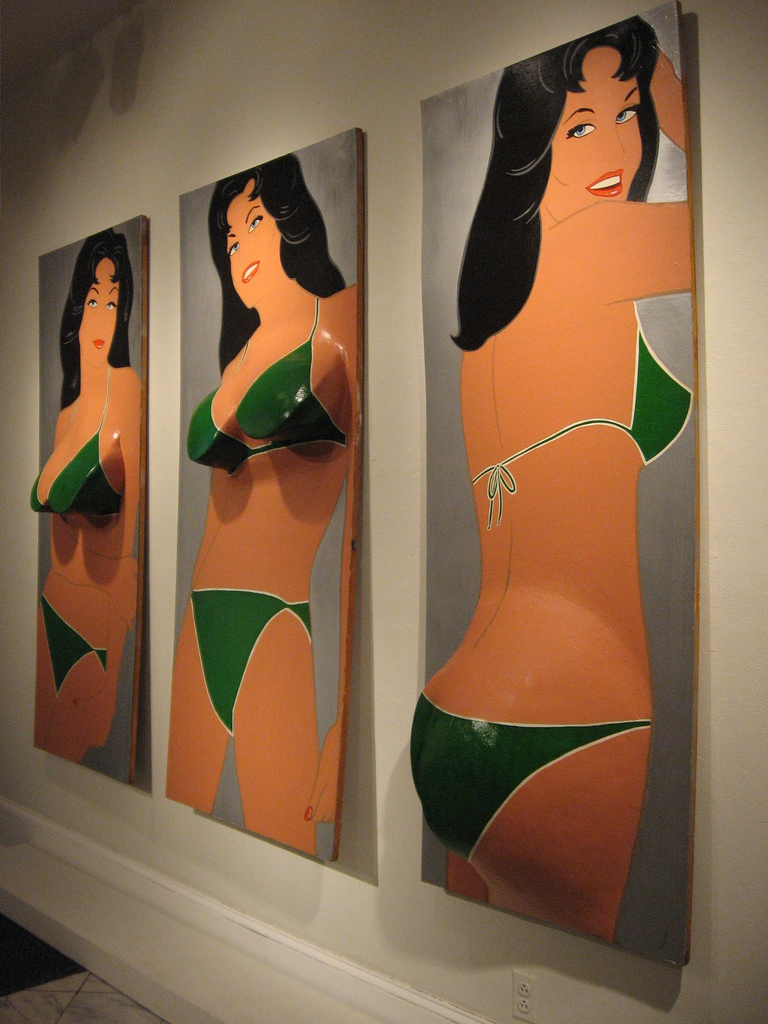
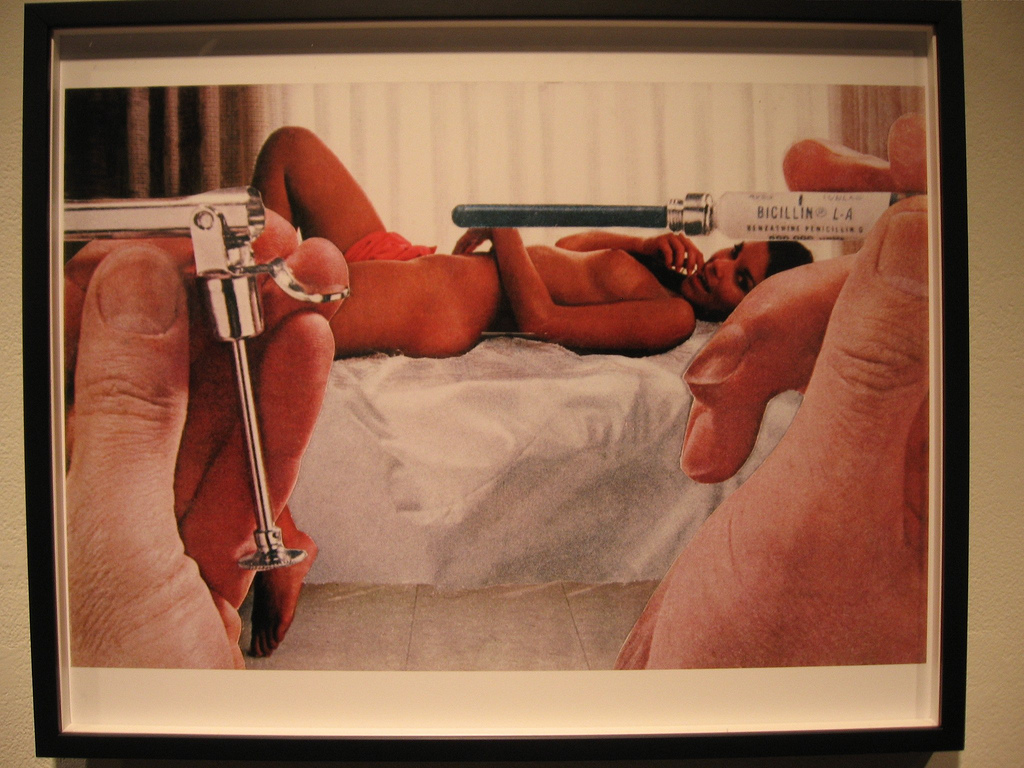
In Rosalyn Drexler’s news-based violent images, men become vectors of oppression and suppression–and dark fantasy. And in Idelle Weber’s Munchkins triptych, men lose their identity in another way, becoming robotic cogs in the wheels of society. Marjorie Strider gives comic-book flat images 3-D elements, for example pumping up a breast into a comic projectile in Green Triptych. Her witty painting Woman with Parted Lips carves an open mouth into a dry cave, hardly the ready, willing and able open mouth of comic books and True Romance.
Evelyne Axell captures the dreamy Peter Max exuberance and graphics of rock album covers in her portrait of Angela Davis and in her Kent State “Campus” painting layered on plexiglas and fiberboard–but with political content, well with content, period.
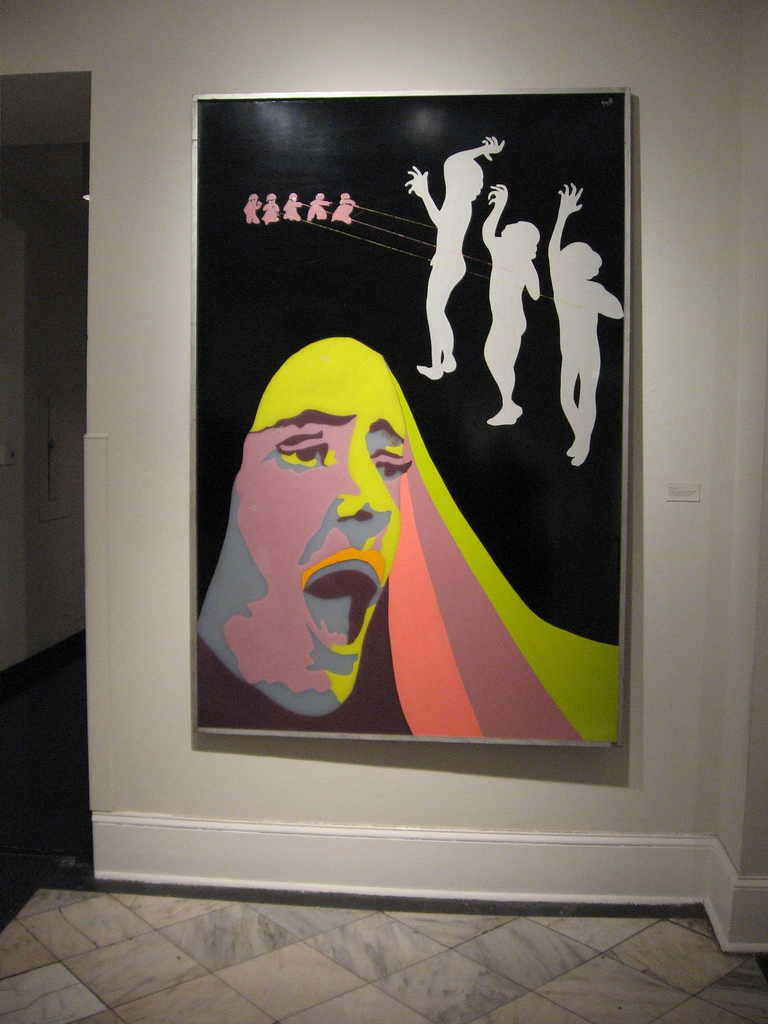
Evelyne Axell, Campus, 1970, enamel on plexiglas and wood fiberboard, Courtesy Mali Antoine-Funakoshi, Jean Antoine and Broadway 1602
That’s part of what makes this show, a serious, art-historical correction, so great. It shows that these women were trivialized, but not trivial. Marisol seems like an obvious example, someone whose work was demeaned as slight and too likable/popular when in fact it is full of content. Sachs’ essay credits the ladies with inventing soft sculpture–a political act of taking art into the sphere of the body and homemaker skills. And they women explore the same slick,male-dominated world of advertising and popular media, inserting their own point of view on women as sexual beings–and it sure is different from how the men view it both in the popular media and in art. They use collage and bricolage, resin and print media, neon and plexiglas, needlework and felt-tipped pens.
Others in the exhibit are Chryssa, Kay Kurt, Mara McAfee, Barbro Ostlihn, Alina Szapocznikow (definitely an outlier with her Art Nouveau romantic style), Joyce Wieland and May Wilson.
There’s lots to see in this exhibit of 19 artists’ works, some of which took years to track down. The exhibit overflows from Rosenwald-Wolf Gallery into the neighboring Hamilton Hall and Borowsky galleries.
Here’s my Flickr set for more photos.

Tags: dorothy grebenak, evelyne axell, idelle weber, marjorie strider, martha rosler, pauline boty, rosalyn drexler, rosenwald-wolf gallery, seductive subversion, university of the arts, women and pop, yayoi kusama
Really liked May Wilson’s Ridiculous Portrait collages.
I’m with Rob on that.
That, too! There was lots of good stuff I didn’t mention. It’s a great show.
I love that painting!
Is the title a specific reference to something? I haven’t had a chance to see the show yet or read any extended statements by the curator, but am troubled. Is it just me, or is there a serious critical question to be asked about the title of the exhibition? In a show curated by a man, what does it mean that the first word in the title is ‘Seductive’? Does that not simply re-inscribe a whole host of outmoded tropes of female representation? Even if it is meant ironically, why do the women have to be ‘seductive’? Can they not be presented in a way that lives up to the critical rhetoric of the exhibition’s stated goals? Why must they be prefaced with a context of seductive longing? If there is irony in the title, it falls short of achieving a chuckle.
Thanks for the post….looks like a great show….wish I lived closer to Philly.
And thanks especially for the coverage of mature women artists. If you get a chance, could we maybe hear/see what they’re doing today? And comments on the balancing act/s-what the felt were the balancing act/s-of then and now. I’d love to know that there’s a gusher just waiting to pour out in our life-after-kids!
Also, and I know this just adds to your workloads and I’m sorry for that, whenever possible, could you give dimensions (or approximations) of the works you show? Often, if there isn’t a person in the picture to give a point of reference, I wonder just how large or small the artist tends to works. THANKS and have a wonderful Valentines Day, gals.
Dear Concerned, I understand your concern, given that it’s women and male curator. (Have you ever met Sid? He is so not an oppressive jerk, so I hate to see him stereotyped like this). I think one of the points of the show was that women’s Pop Art had heat and passion in it (as compared to the chilly guys), and the women used that heat to subvert those very stereotypes you are concerned about. The women were looking at how they were seen in advertising and the culture of the time, and they were raising questions, challenging the male gaze and the belittling point of view that gulaged them into the kitchen. I understand your sensitivity to the issue, but Seductive is only the adjective here. Subversion is the power word–the noun. And honestly, while I get your point, I figure if that word brings misguided leerers into see the show, it’s worth it. Let’em look and learn.
Hi, Treena, There were some online video interviews of some of the women in the exhibit, but they seem to have been taken down. I will ask about them, and if I find them, I will add the info here.
Of course it’s better with the dimensions, and we’ve gotten better about it. If my check list press info is digitized and includes dimensions, they get added. Otherwise, it’s catch as catch can; I am slow typing numbers and inch and feet symbols. If there’s a specific piece that frustrated you, let me know and I’ll do my best to let you know its scale.
Hi Libby,
I like your response to concerned. I agree–I think subversion is very seductive. And as we all know, a hot title will get folks in door. Looking forward to seeing the exhibit. Have you been to Strictly Death at Slought yet? I’m writing on it for Afterimage. Very interesting show–where else can you see The Chapman Brothers next to a Goya?
Hi, Colette, I haven’t yet been to Slought. It’s so close to my house I’m generally late on getting there. And speaking of seductive, your thumbnail of chapmans next to goya is irresistable.
Dear Concerned,
The title of the exhibition was pulled from an essay by Linda Nochlin which will be printed in the catalog. The original title of the project was Beyond the Surface: Women and Pop Art 1958 – 1968. And yes it was changed as one of the venues was concerned that my more academic title (still the title of my catalog essay) would not get the audience they wanted into the door.
As for my being male, mea culpa. I was helped in my selections by Kalliopi Minioudaki, a female curator.
I invite you to see the exhibit. And await your comments after actually seeing the work.
Hi, Sid, Thanks for adding that comment. But I am so sad that it comes to this he vs. she, at this very moment when there’s a show that aims to correct past slights. Better to expend one’s bile at the preponderance of shows that slight women altogether. That might be a more balanced approach.