November 2, 2010 · 3 Comments
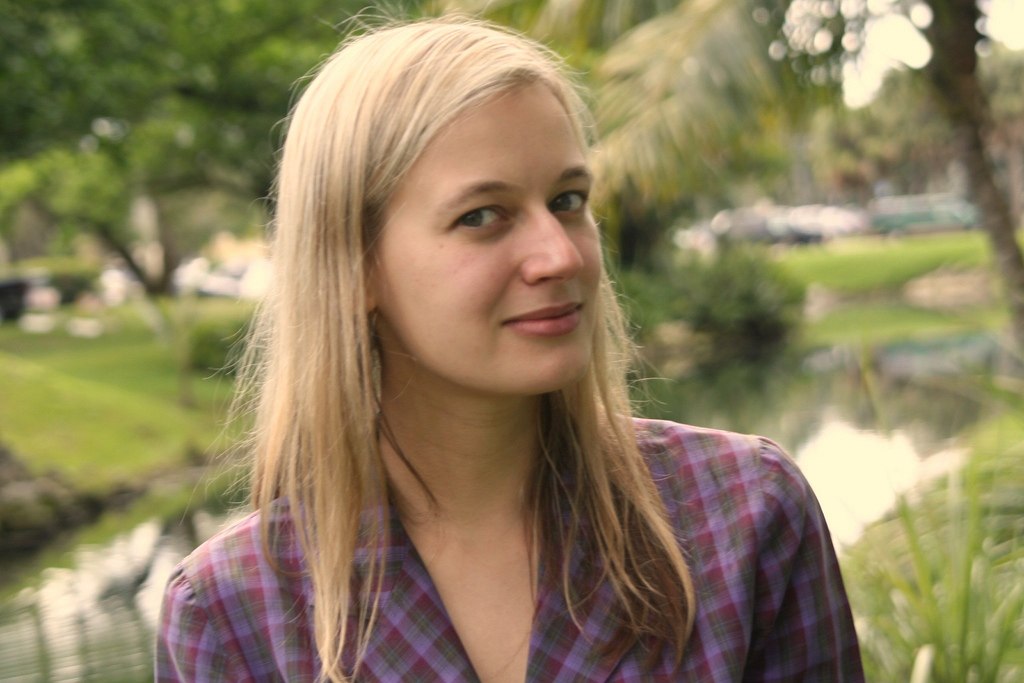
Lauren Cornell, executive director of Rhizome and New Museum adjunct curator, is the curator of the New Museum’s current exhibit, Free (info about the show is at the end of the interview). Cornell answered Corey Armpriester’s questions via email.
Corey Armpriester: What inspires your curatorial ideas?
Lauren Cornell: Its hard to pinpoint inspiration to a single moment. I show artists, write about their work, fundraise for projects, constantly—I always feel a sense of urgency about what I do. Art isn’t a day job for me, its my life.
CA: Can you talk about the art you live with in your home?
LC: Looking around my room right now: I have a painting by Leidy Churchman on my wall, a drawing by A.K. Burns hangs over my bed, a print by Matt Keegan sits on my dresser next to next to a poster I took from A.L. Steiner that she’d made for the band Chicks on Speed, it says ‘Free Thinking is For Free.’ I have a new album by Nancy Garcia on my desk, its sitting on a drawing Kara Walker did of me on a placemat at Café Gitane. It was the first time I met her and she just drew everyone’s picture at the table; it’s the best portrait of myself I’ve ever had. I also have a calendar by Tauba Auerbach hanging in my window.
I used to run a screening series in Brooklyn, I also juried several experimental film/video festivals and now see works by artists constantly on dvd and online, so I have an outrageous number of videos—in all different formats—in boxes in my closet, in drawers, sometimes playing. I was just looking at a video by Jem Cohen from 2003 that I have a screener of, because I was thinking about writing about it, so its mini-dv jacket sits on my desk. I could start an Ubuweb that would chart the 00’s, but I won’t.
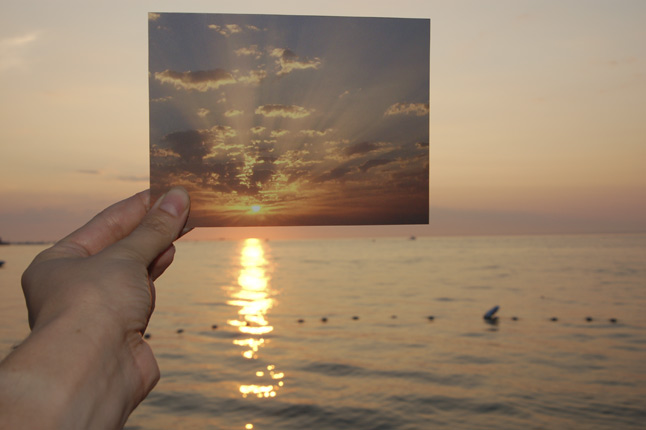
Lisa Oppenheim, The Sun is Always Setting Somewhere Else, 2006 – 35mm slide projection, in Free at the New Museum
CA: As a curator what is most important to you, talent or technique?
LC: There are so many things that draw me to artists. It really depends. I think about how art relates to art history, and also to contemporary culture. I’ve noticed that I am often drawn to artists who write. I also like activist types, because I used to be more of one myself.
CA: How often do you look at the work of artists selling their art on the streets of NYC? Do you have a favorite street location?
LC: My mom buys work from artists outside the Met. I’ll look with her. Otherwise, I don’t really. I look at art on the streets of the Internet, by which I mean animated gifs, and other seemingly random, amazing visual culture.
CA: Can people get into the New Museum for free to see your next exhibition “Free”?
LC: Yes, every Thursday from 7-9 pm the New Museum offers free admission, but during regular museum hours, no, it costs $12 ($10 seniors, $8 students, 18 under always free). I was thinking Free as in Freedom not Free as in Free Beer to quote the founder of the open source movement Richard Stallman. “Free” doesn’t include open source works, I should qualify, but they do touch upon the the ethics, problems and possibilities of a new landscape for information.
CA: What’s the kindest thing an artist has done for you?
LC: Hard to say.
CA: Has the internet become the center of the art world?
LC: No, but its helped decentralize it.
The 22 artists featured in Free come from around the world, and include Lizzie Fitch, Ryan Trecartin, Takeshi Murata and Rashaad Newsome (full list and online show catalog here). The exhibit is inspired in part by an essay by participating artist Seth Price. The essay, “Dispersion” traces how culture is increasingly dispersed via media from print to video to the web, and how this shift has changed what public and popular mean to art making. The works in “Free” explore art’s relationship to the web.
–Corey Armpriester is a Philadelphia artist and photographer.
Tags: free, jd lasica, lauren cornell, lisa oppenheim, new museum, rashaad newsome, rhizome, trevor paglen
I love the idea of “free” in a museum, but then again, hasn’t the net become the most massive museum on the planet. The question now, it seems, are people content with looking at computer screens to access culture and visual art? Just as so much work in contemporary exhibitions consists of…video.
For years people made the argument that watching a video on a home tee vee screen was inferior by far to “experiencing” the “film” in a cinema. Smell, touch, the process and the price probably accounted for something; and of course, size matters. But does it?
Perhaps the notion of walking through a space and discovering things that attract you, while slow compared to a fibre optic connection, has more meaning, or more depth…because it’s slow. I’m curious how years of photons striking my neural net via the internet affects what I see when I walk outside, or see the real thing (if it’s art we’re talking about) in a museum. Perhaps it’s the place after all.
A museum is a curated collection –to that extent it’s not a free for all. The internet might also be a museum — I think that’s a great call, Matthew — but it’s not curated. It is a free for all. Museums deliver a program that’s been vetted. You must vet the internet yourself.
One reason people go to museums is to give themselves over to the experience of being taken along for the curatorial ride.
The internet requires self-curating. You can go to the email wing, the facebook wing, the flickr wing, the netflix, huloo, etsy, ebay or zillions of other wings of the www. People help each other navigate the internet, thus becoming curators of what they know. In that respect the internet is democratic. But there are so many wings in the museum that it’s still overwhelming, and frustrating and alienating, too.
I love the internet. The virtual experience is seductive–it’s so easy. Just push a button or two and you’re in there. But it can be a frigid and alienating experience. It’s really not so much fun to laugh out loud alone.
I do worry, like you, Matthew, about those neural networks being hardwired for getting pleasure looking at a screen instead of looking at the real world. Among other things I’ve been told that when you’re looking at a computer screen you blink less and thus your eyes get dry. Over time will nature compensate for this, creating people who blink less because they surf more?
The idea of dispersion and the proliferation of information along the archives of the internet as a form of “freedom” or “free” culture seems tragically misguided and ultimately proliferates little more than an acute ideological colonialism. Of course I attended the exhibition in the hopes of being engaged or educated but found only surfaces and departed with the impression that someone had sought to pull the wool over my eyes. Yes, more people will experience cat videos and pornography on private monitors than engaging in shared experiences in a town common or with some outsized sculpture in a supposedly public space, but what does that mean? Sure, I benefit from locating and learning about products, ideas, actions, and events from the internet to the point where it is difficult to imagine what it was like before this resource was available, but we cannot propose that this all occurs on an ivory cloud detached from that which is base; that which is unsavory; that which turns off the seduction. We are worse off for the occlusion of the latter element.
The artists and consumers (museum patrons, etc.) of this affair seem to be in all cases – regardless of nationality or other arbitrary form of differentiation – the beneficiaries of the communication age and its phantasmagoria of speed and consumption. Within, the internet is understood little beyond being a black box incomprehensible in its encoding. In the most plainly simple way this endeavor has managed to swallow its own rhetoric whole and offer an impression of social relationships mediated by objects as a means of enlightenment as opposed to an advanced form of commodity fetishism.
Also, it should be noted as somewhat inopportune that this utopian affirmation of the internet and its inauspicious denial of its own materiality should open only a few blocks away from the somewhat similarly themed (distribution of materials), though ever-more rigorous, program at Cooper Union, “The Crude and the Rare” which, in its better offerings (Ursula Biemann, Alfredo Jaar, etc.), reminds us of the ecological and geopolitical ramifications of our banal privileged existences. Not only is it laughable to suggest that the content of luxury goods in an endless cycle of obsolescence is somehow free (in terms of either culture or price-tag) but to refuse to acknowledge the part this plays in the global slave-ship of commerce and the sourcing of goods or the environmental degradation that results from both the sourcing and surfeit waste of said goods thrown out regularly for the better, faster, newer thing is not just careless, but intellectually dishonest.